


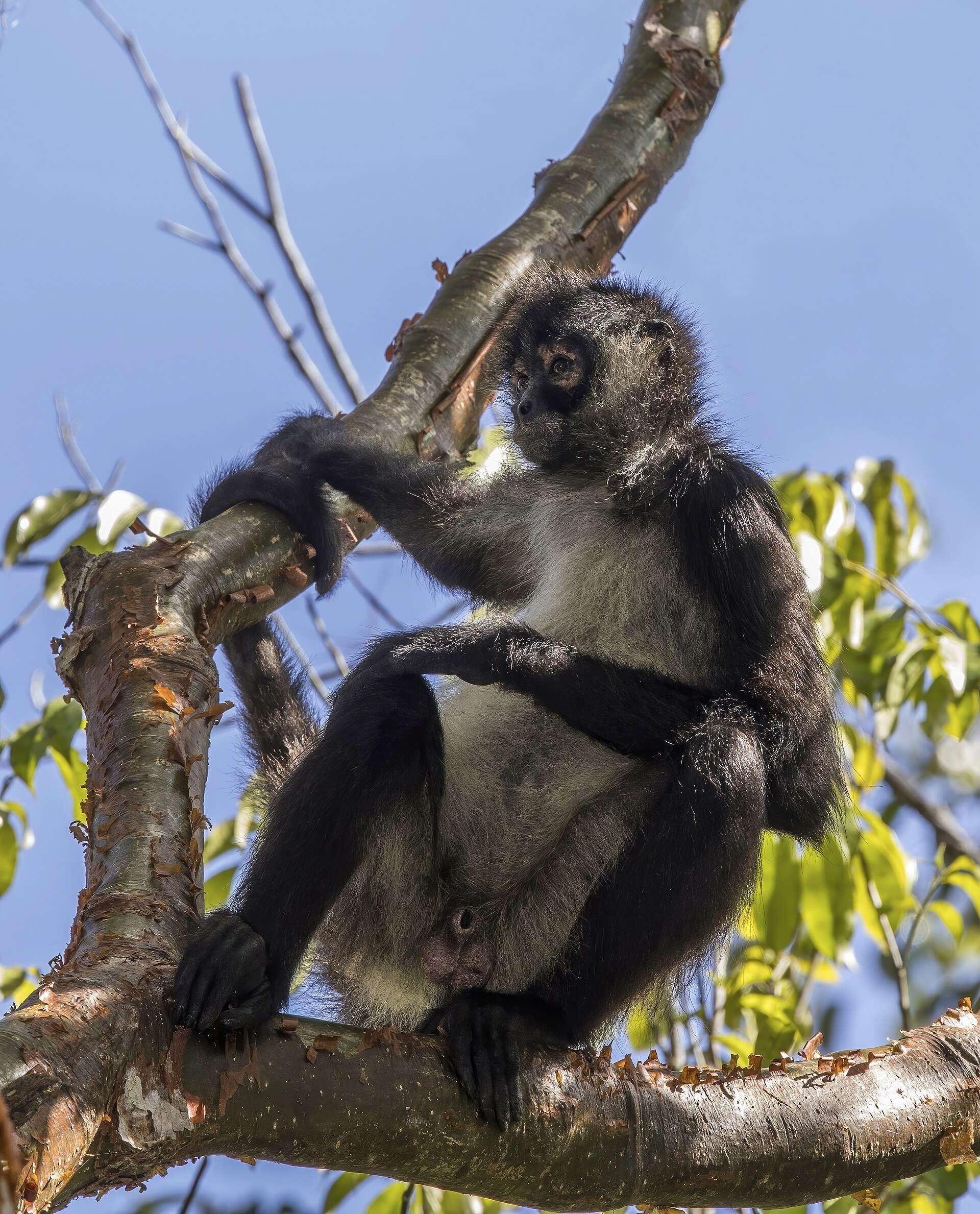
BLACK-HANDED SPIDER MONKEY
Atelus geoffroyi
DESCRIPTION
Black-handed Spider Monkey (Atelus geoffroyi) is a medium-sized primate known for its long limbs and prehensile tail, which it uses for grasping branches as it moves through the trees. This species has a distinctive black coloration on its hands and face, contrasting with its lighter body fur. They are highly social animals, often found in groups, and are known for their acrobatic abilities and vocalizations, which play a crucial role in their communication and social interactions.
FUN FACTS
- Black-handed Spider Monkeys are known for their unique vocalizations, which can be heard over long distances and are used to communicate with other members of their group
- They also have a highly developed sense of social structure, often forming strong bonds with one another, which is essential for their survival in the wild.|These monkeys are among the most acrobatic of all primates, capable of swinging from branch to branch with incredible speed and agility
- Their prehensile tails are not just for balance; they can grasp and hold onto branches, allowing them to navigate their forest habitat with ease
QUICK INFO
Lifespan20-25 years in the wild, up to 30 years in captivi
Average Weight15-19 kg
Average Length50-70 cm
Diet TypeHerbivore
Social StructureThey live in social groups, typically consisting of 10-30 individuals, which are often matriarchal.
Activity PatternDiurnal
Breeding SeasonYear-round, with peaks depending on the region
- Habitat
- Black-handed Spider Monkeys inhabit tropical rainforests and moist lowland forests, where they can find ample food and climbing opportunities. They are arboreal, spending most of their time in the trees.
- Biomes
- Tropical Rainforest
- Native Range
- They are native to Central America, specifically found in countries such as Mexico, Guatemala, Honduras, Nicaragua, and Costa Rica.
- Continent
- North America, Central America
- Countries
- Mexico, Guatemala, Honduras, Nicaragua, Costa Rica
- Diet
- They primarily consume fruits, leaves, and flowers, with a preference for ripe fruits when available.
- Diet Type
- Herbivore
- Favorite Food
- Fruits, leaves
- Social Structure
- They live in social groups, typically consisting of 10-30 individuals, which are often matriarchal.
- Activity Pattern
- Diurnal
- Group Size
- 10-30
- Territorial
- 1
 VU
VU
 NT
NT
15-19 kg
Weight
50-70 cm
Length
- Coloration
- They have a light brown to tan body with darker limbs and a distinctive black face and hands.
- Sexual Dimorphism
- Males are generally larger than females.
- Lifespan
- 20-25 years in the wild, up to 30 years in captivi
- Gestation Period
- 230-240 days
- Offspring per Birth
- 1
- Sexual Maturity
- 4-5 years
- Breeding Season
- Year-round, with peaks depending on the region
EN
Endangered
IUCN Red List Status
- Population Status
- The population is currently declining due to habitat loss and hunting.
- Wild Population Estimate
- 20,000-30,000
- Population Trend
- Decreasing
- Endangered
- 1
- Threats
- Main threats include deforestation due to agriculture and logging, as well as hunting for bushmeat. Habitat fragmentation also poses a significant risk to their populations.
- Predators
- Large birds of prey, jaguars, and humans are known predators of the Black-handed Spider Monkey.
- Defense Mechanisms
- They rely on their agility and ability to escape into the treetops to avoid predators.
- Compatible Animals
- Other primates, such as capuchins and tamarins, in zoo settings
- Found in Zoos
- Uncommon