


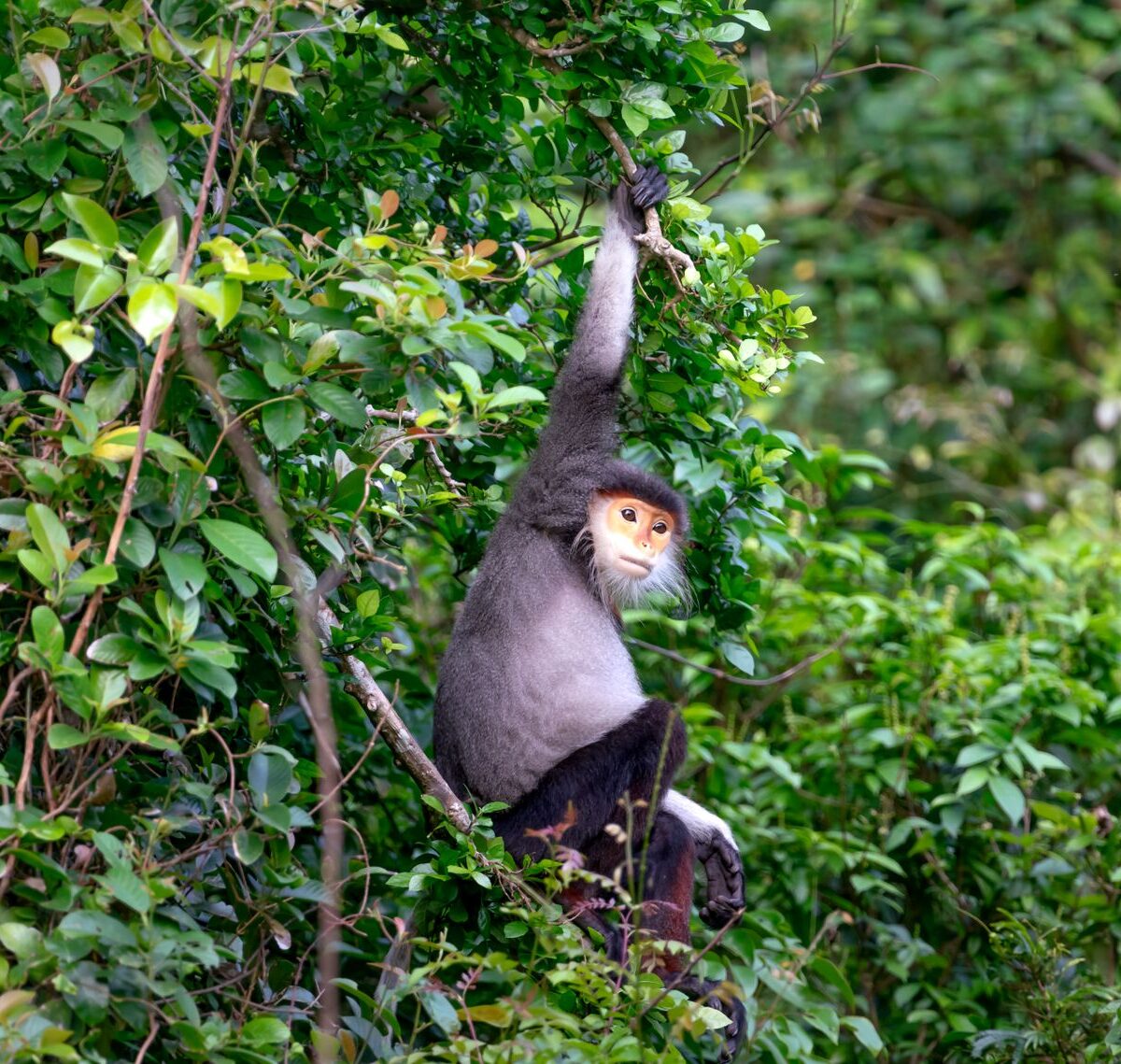
BLACK-SHANKED DOUC LANGUR
Pygathrix nigripes
DESCRIPTION
Black-Shanked Douc Langur (Pygathrix nigripes) is a striking primate known for its vibrant coloration, featuring a mix of black, white, and orange fur. This species is arboreal, spending most of its time in the treetops of tropical forests, where it is highly agile and adept at leaping between branches. Socially, they live in groups, exhibiting complex behaviors and vocalizations that facilitate communication among members.
FUN FACTS
- Black-Shanked Douc Langurs are known for their acrobatic skills, often performing impressive leaps between branches that can span several meters
- Their social interactions are complex, with individuals forming strong bonds and engaging in grooming behaviors that help maintain group cohesion.|These langurs have a unique vocalization system, using a variety of calls to communicate with each other
- Their vocalizations can be heard over long distances, which is essential for maintaining contact in the dense forest environment
QUICK INFO
Lifespan15-20 years in the wild, up to 30 in captivity
Average Weight6-10 kg
Average Length50-75 cm
Diet TypeHerbivore
Social Structuregroup — they live in small to medium-sized groups, often consisting of several females and their offspring, along with a few males.
Activity PatternDiurnal
Breeding SeasonYear-round, with peaks during the rainy season
- Habitat
- Black-Shanked Douc Langurs inhabit tropical rainforests, particularly in areas with dense foliage that provides ample food and shelter. They are often found in hilly or mountainous regions, where they can navigate the canopy with ease.
- Biomes
- Tropical Rainforest
- Native Range
- This species is native to the central highlands of Vietnam and parts of Laos.
- Continent
- Asia
- Countries
- Vietnam, Laos
- Diet
- They primarily consume leaves, fruits, and flowers, with a preference for young leaves that are easier to digest. Their diet is rich in fibrous plant material, which they process with their specialized digestive systems.
- Diet Type
- Herbivore
- Favorite Food
- young leaves, fruits, flowers
- Social Structure
- group — they live in small to medium-sized groups, often consisting of several females and their offspring, along with a few males.
- Activity Pattern
- Diurnal
- Group Size
- 5-15
- Territorial
- 1
6-10 kg
Weight
50-75 cm
Length
- Coloration
- They have a distinctive coloration with a black face, white whiskers, and orange-brown fur on their limbs and back.
- Sexual Dimorphism
- Males are generally larger than females and have more pronounced coloration.
- Lifespan
- 15-20 years in the wild, up to 30 in captivity
- Gestation Period
- 165 days
- Offspring per Birth
- 1
- Sexual Maturity
- 3-4 years
- Breeding Season
- Year-round, with peaks during the rainy season
EN
Endangered
IUCN Red List Status
- Population Status
- The population is currently declining due to habitat loss and hunting.
- Wild Population Estimate
- Less than 2,500 individuals
- Population Trend
- Decreasing
- Endangered
- 1
- Threats
- The main threats to the Black-Shanked Douc Langur include habitat destruction due to logging and agricultural expansion, as well as hunting for bushmeat and the illegal pet trade. These pressures have significantly reduced their population in the wild.
- Conservation Program
- Conservation efforts are underway in Vietnam, including habitat protection and anti-poaching initiatives.
- Predators
- Main predators include large birds of prey and possibly snakes, although specific predator relationships are not well-documented.
- Defense Mechanisms
- They rely on their agility and speed to escape predators, often using the dense canopy for cover.
- Found in Zoos
- Uncommon