


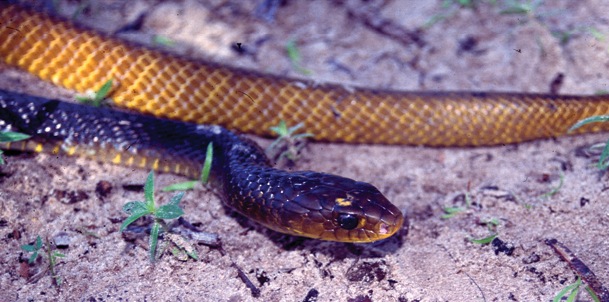
BLACKTAIL CRIBO
Drymarchon corais
DESCRIPTION
Blacktail Cribo (Drymarchon corais) is commonly known as the Eastern Cribo and is recognized for its striking appearance, featuring a long, slender body that can reach impressive lengths of up to 3 meters. This species exhibits a glossy black coloration on its tail, which contrasts with its lighter body, often adorned with shades of gray or brown. Behaviorally, Blacktail Cribo is known for its agility and ability to climb, making it an adept predator in various environments, where it plays a crucial role in controlling rodent populations.
FUN FACTS
- Blacktail Cribo is known for its impressive climbing abilities, often seen ascending trees in search of prey or basking in the sun
- Additionally, this species has a unique method of locomotion, allowing it to move swiftly and gracefully through its environment, making it a fascinating subject for herpetologists and snake enthusiasts alike
QUICK INFO
Lifespan10-15 years in the wild, up to 20 years in captivi
Average Weight2-4 kg
Average Length2-3 m
Diet TypeCarnivore
Social Structuresolitary, occasionally pairs during breeding
Activity PatternDiurnal
Breeding SeasonSpring (April-June)
- Habitat
- This species thrives in a variety of habitats, including forests, grasslands, and scrublands. It is often found near water sources, which provide essential resources for hunting and hydration.
- Biomes
- Tropical Rainforest, Temperate Forest, Grassland
- Native Range
- Blacktail Cribo is native to Central America and parts of the southern United States, extending from Mexico to Florida.
- Continent
- North America, Central America
- Countries
- Mexico, United States, Belize, Guatemala, Honduras, Nicaragua, Costa Rica, Panama
- Diet
- Blacktail Cribo primarily feeds on small mammals, birds, and other reptiles, showcasing its role as a carnivorous predator. Its hunting strategy often involves ambushing prey or actively searching through vegetation.
- Diet Type
- Carnivore
- Favorite Food
- small mammals, birds, reptiles
- Social Structure
- solitary, occasionally pairs during breeding
- Activity Pattern
- Diurnal
- Group Size
- 1-2
- Territorial
- 0
 VU
VU
2-4 kg
Weight
2-3 m
Length
- Coloration
- glossy black tail with lighter body colors
- Lifespan
- 10-15 years in the wild, up to 20 years in captivi
- Offspring per Birth
- 5-15
- Sexual Maturity
- 2-3 years
- Breeding Season
- Spring (April-June)
LC
Least Concern
IUCN Red List Status
- Population Status
- The population of Blacktail Cribo is currently stable, though local declines may occur due to habitat loss.
- Wild Population Estimate
- unknown
- Population Trend
- Stable
- Endangered
- 0
- Threats
- Main threats include habitat destruction due to agriculture and urban development, as well as persecution due to fear of snakes. Conservation efforts are needed to ensure their habitats remain protected.
- Predators
- Birds of prey, larger snakes, and mammals such as raccoons may prey on Blacktail Cribo, particularly when they are young or vulnerable.
- Defense Mechanisms
- Blacktail Cribo can exhibit defensive behaviors such as hissing and striking when threatened, and its agility allows it to escape quickly.
- Found in Zoos
- Uncommon