


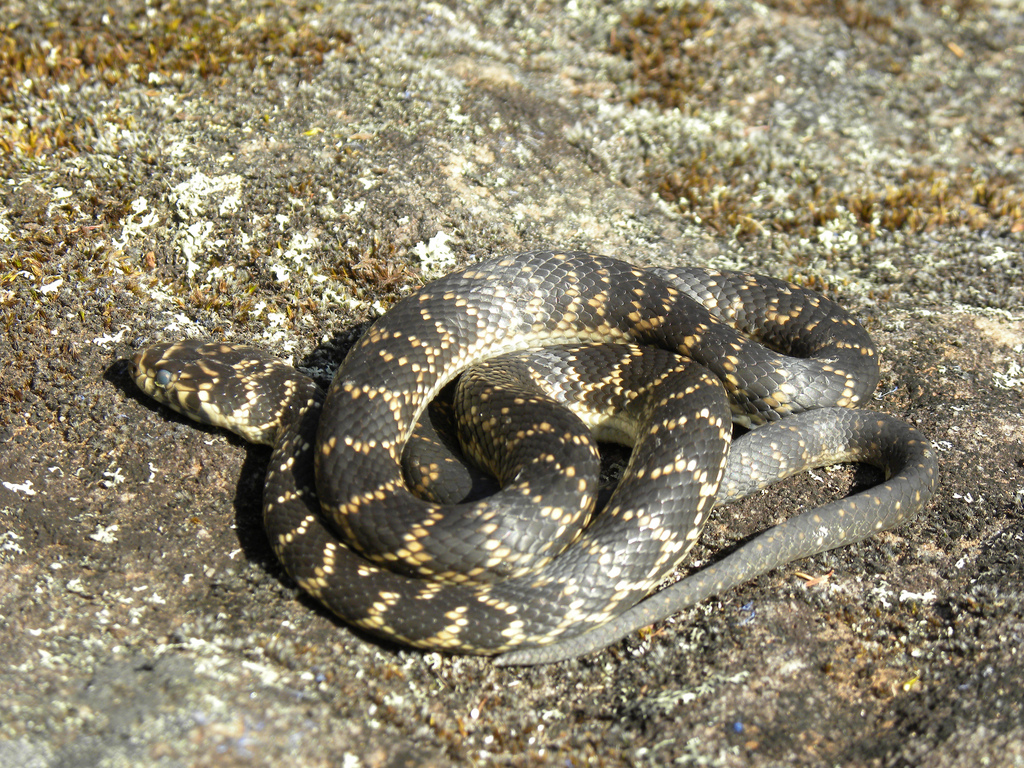
BROAD-HEADED SNAKE
Hoplocephalus bungaroides
DESCRIPTION
Broad-headed Snake (Hoplocephalus bungaroides) is a distinctive species known for its broad, flattened head and striking coloration, which typically includes shades of brown, gray, and black. This snake is primarily found in the forests and woodlands of eastern Australia, where it exhibits a preference for rocky outcrops and dense vegetation. It is a semi-arboreal species, often seen basking on branches or rocks, and is known for its secretive behavior, making it a challenge to observe in the wild.
FUN FACTS
- The Broad-headed Snake is known for its unique hunting technique, where it will often ambush its prey from a concealed position, using its excellent camouflage to blend into the environment
- Additionally, this species has a fascinating reproductive strategy, as it is oviparous, laying eggs that hatch into fully formed young snakes, which are independent from birth.| Despite its venomous nature, the Broad-headed Snake is not considered a significant threat to humans, as bites are rare and usually occur only when the snake is provoked or handled improperly
QUICK INFO
Lifespan10-15 years in the wild, up to 20 years in captivi
Average Length1.2-1.5 m
Diet TypeCarnivore
Social Structuresolitary
Activity PatternDiurnal
Breeding SeasonSpring (September-November)
- Habitat
- This species inhabits a variety of forested environments, including dry sclerophyll forests and moist rainforests. They are often found near rocky areas where they can hide and hunt.
- Biomes
- Temperate Forest, Tropical Rainforest
- Native Range
- The native range of the Broad-headed Snake is limited to the eastern regions of Australia, particularly in New South Wales and parts of Queensland.
- Continent
- Australia
- Countries
- Australia
- Diet
- Broad-headed Snakes primarily feed on small mammals, lizards, and occasionally other snakes. They are known to use their venom to subdue prey before consumption.
- Diet Type
- Carnivore
- Favorite Food
- small mammals, lizards
- Social Structure
- solitary
- Activity Pattern
- Diurnal
- Group Size
- 1
- Territorial
- 0

 VU
VU
1.2-1.5 m
Length
- Coloration
- The coloration of the Broad-headed Snake varies but typically includes a mix of browns and grays with darker bands or blotches.
- Sexual Dimorphism
- Males tend to be smaller and have a more pronounced coloration compared to females.
- Lifespan
- 10-15 years in the wild, up to 20 years in captivi
- Sexual Maturity
- 2-3 years
- Breeding Season
- Spring (September-November)
EN
Endangered
IUCN Red List Status
- Population Status
- The population of Broad-headed Snakes is currently considered to be declining due to habitat loss and fragmentation.
- Wild Population Estimate
- unknown
- Population Trend
- Decreasing
- Endangered
- 1
- Threats
- Main threats to the Broad-headed Snake include habitat destruction due to urban development and agriculture, as well as predation by invasive species such as foxes and cats.
- Conservation Program
- Conservation efforts are underway to protect their habitats and manage invasive species.
- Predators
- foxes, cats, birds of prey
- Defense Mechanisms
- Broad-headed Snakes may use their venom to deter predators, and they can also exhibit defensive behaviors such as flattening their bodies and hissing.
- Found in Zoos
- Uncommon