


BROWN-EARED PHEASANT
Crossoptilon mantchuricum
DESCRIPTION
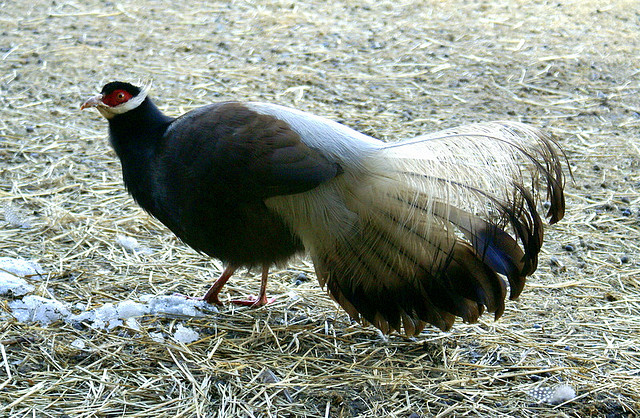
Brown-eared Pheasant (Crossoptilon mantchuricum) is also known as the Manchurian Pheasant, a striking bird native to the forests of northeastern China and parts of Mongolia. This species is characterized by its long tail, distinctive ear tufts, and a mix of brown, gray, and white plumage that provides excellent camouflage in its natural habitat. Brown-eared Pheasants are ground-dwelling birds that prefer to forage in dense underbrush, where they can be elusive and secretive, often relying on their cryptic coloration to avoid predators.
FUN FACTS
- Brown-eared Pheasants are known for their elaborate courtship displays, where males perform intricate dances and vocalizations to attract females
- These displays are not only a means of attracting mates but also serve to establish dominance among competing males
- | The species is named for the distinctive ear tufts that resemble feathers, which are more pronounced in males
- These tufts are thought to play a role in communication and mating displays, making them a unique feature among pheasants
QUICK INFO
Lifespan10-15 years in the wild, up to 20 in captivity
Average Weight1.5-2.5 kg
Average Length70-80 cm
Diet TypeOmnivore
Social StructureThey are typically solitary or found in small family groups, especially during the breeding season.
Activity PatternDiurnal
Breeding SeasonSpring (April-June)
- Habitat
- Brown-eared Pheasants inhabit temperate forests, particularly in areas with dense undergrowth and shrubbery. They prefer regions with a mix of open spaces and cover for foraging and nesting.
- Biomes
- Temperate Forest
- Native Range
- The native range of the Brown-eared Pheasant includes northeastern China and parts of Mongolia.
- Continent
- Asia
- Countries
- China, Mongolia
- Diet
- They primarily feed on seeds, fruits, and insects, foraging on the forest floor. Their diet varies seasonally, with a greater emphasis on plant material during the warmer months.
- Diet Type
- Omnivore
- Favorite Food
- seeds, fruits, insects
- Social Structure
- They are typically solitary or found in small family groups, especially during the breeding season.
- Activity Pattern
- Diurnal
- Group Size
- 1-5
- Territorial
- 0

 VU
VU
1.5-2.5 kg
Weight
70-80 cm
Length
- Coloration
- The plumage is predominantly brown with gray and white accents, featuring distinctive ear tufts.
- Sexual Dimorphism
- Males are generally larger and more vibrantly colored than females.
- Lifespan
- 10-15 years in the wild, up to 20 in captivity
- Offspring per Birth
- 5-10 eggs
- Sexual Maturity
- 1 year
- Breeding Season
- Spring (April-June)
EN
Endangered
IUCN Red List Status
- Population Status
- The population of Brown-eared Pheasants is currently declining due to habitat loss and hunting.
- Wild Population Estimate
- 10,000-20,000
- Population Trend
- Decreasing
- Endangered
- 1
- Threats
- Main threats include habitat destruction due to deforestation and agricultural expansion, as well as hunting pressures. Conservation efforts are needed to protect their remaining habitats.
- Predators
- Foxes, birds of prey, and domestic dogs are known predators of the Brown-eared Pheasant.
- Defense Mechanisms
- They rely on their camouflage and secretive behavior to avoid detection by predators.
- Found in Zoos
- Uncommon