


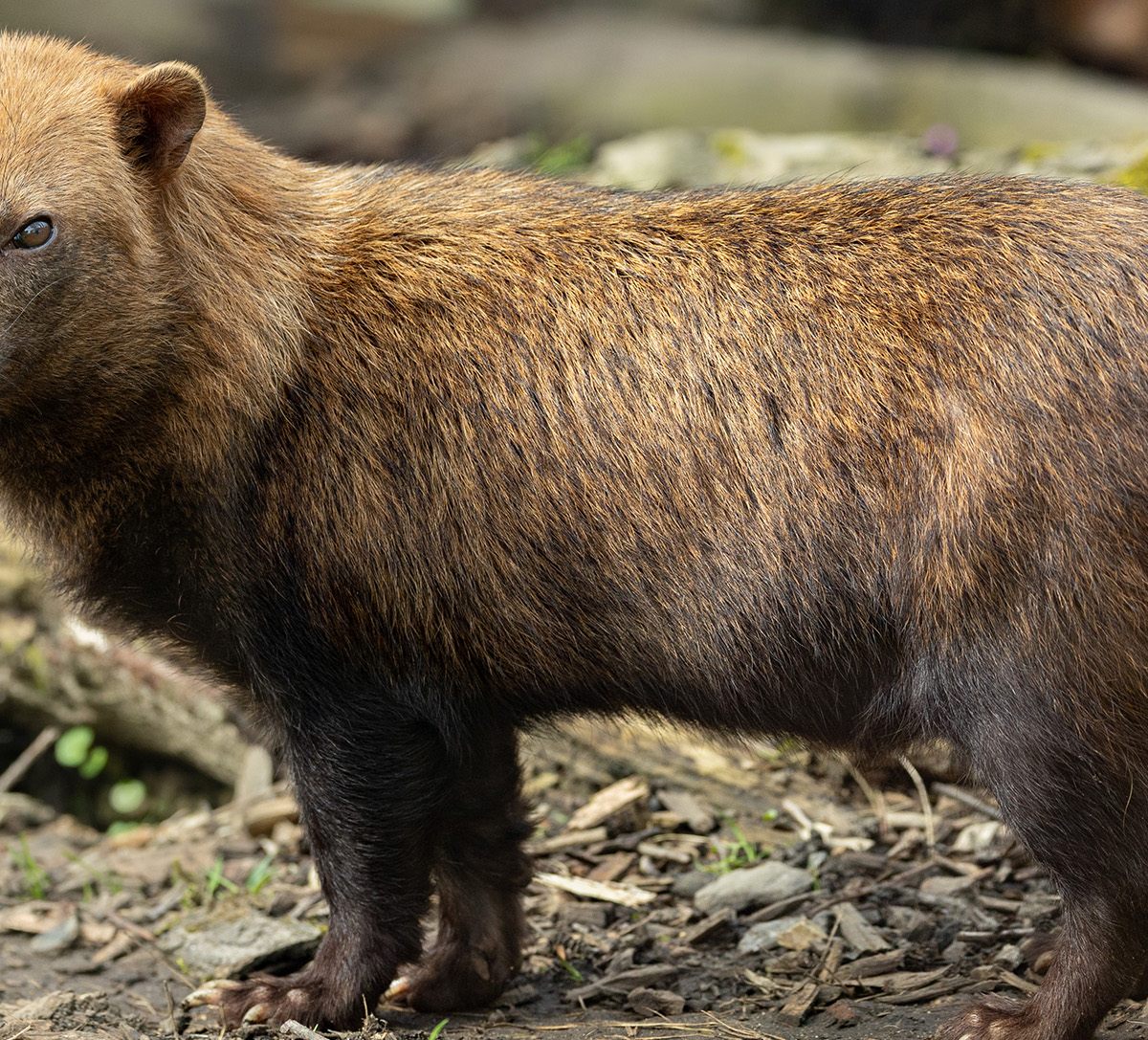
BUSH DOG
Speothos venaticus
DESCRIPTION
Bush Dog is commonly known as the Savanna Dog and Pampas Dog. This small canid has a unique appearance with a compact body, short legs, and a distinctive coat that ranges from reddish-brown to dark brown. They are highly social animals, often found in small groups, and are known for their playful behavior and strong bonds with their pack members.
FUN FACTS
- Bush Dogs have a unique hunting strategy that involves teamwork, allowing them to take down prey much larger than themselves
- They are also known for their distinctive vocalizations, which include a variety of barks and howls that help maintain group cohesion and communication in the wild
QUICK INFO
Lifespan10-15 years in the wild, up to 20 in captivity
Average Weight7-10 kg
Average Length60-75 cm
Diet TypeCarnivore
Social StructureBush Dogs typically live in small family groups, often consisting of a breeding pair and their offspring. They exhibit strong social bonds and cooperative hunting behaviors.
Activity PatternCrepuscular
Breeding SeasonYear-round, with peaks depending on the region
- Habitat
- Bush Dogs inhabit a variety of environments, including tropical forests, savannas, and wetlands. They prefer areas with dense vegetation that provide cover for hunting and denning.
- Biomes
- Tropical Rainforest, Savanna, Wetlands
- Native Range
- Bush Dogs are native to Central and South America, primarily found in countries like Brazil, Bolivia, and Paraguay.
- Continent
- South America
- Countries
- Brazil, Bolivia, Paraguay, Argentina
- Diet
- Bush Dogs primarily feed on small mammals, birds, and reptiles, utilizing their keen sense of smell to hunt. They are known to hunt cooperatively, which enhances their success in capturing prey.
- Diet Type
- Carnivore
- Favorite Food
- small mammals, birds
- Social Structure
- Bush Dogs typically live in small family groups, often consisting of a breeding pair and their offspring. They exhibit strong social bonds and cooperative hunting behaviors.
- Activity Pattern
- Crepuscular
- Group Size
- 2-10
- Territorial
- 1
7-10 kg
Weight
60-75 cm
Length
- Coloration
- reddish-brown to dark brown with a lighter underbelly
- Sexual Dimorphism
- males are slightly larger than females
- Lifespan
- 10-15 years in the wild, up to 20 in captivity
- Gestation Period
- 60-70 days
- Offspring per Birth
- 2-6
- Sexual Maturity
- 1-2 years
- Breeding Season
- Year-round, with peaks depending on the region
VU
Vulnerable
IUCN Red List Status
- Population Status
- Bush Dog populations are currently fragmented and declining due to habitat loss and hunting.
- Wild Population Estimate
- unknown
- Population Trend
- Decreasing
- Endangered
- 1
- Threats
- The main threats to Bush Dogs include habitat destruction due to agriculture and urbanization, as well as hunting for their pelts. These factors have led to a decline in their populations across their range.
- Predators
- Large cats such as jaguars and pumas may prey on Bush Dogs, particularly when they are young or vulnerable. Additionally, humans pose a significant threat through hunting and habitat encroachment.
- Defense Mechanisms
- Bush Dogs rely on their social structure and cooperative behavior to defend against predators, often using vocalizations to alert the group of danger.
- Found in Zoos
- Uncommon