


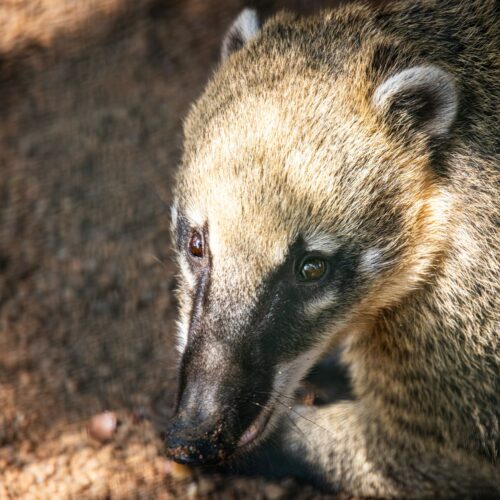
COATI
Nasua narica
DESCRIPTION
Coatis are medium-sized mammals with long, slender bodies and a distinctive long, ringed tail that they often hold upright. They have a pointed snout and a face that resembles that of a raccoon, with dark markings around the eyes. Coatis are known for their curious and social behavior, often seen foraging in groups and using their keen sense of smell to locate food.
FUN FACTS
- Coatis are known for their unique social structure, where females and their young form groups while males tend to be solitary
- This social behavior is quite fascinating, as it allows for cooperative foraging and protection against predators
- | Coatis have a highly developed sense of smell, which they use to locate food
- They often dig in the ground or under leaves to find insects and other food items, showcasing their intelligence and adaptability in various environments
QUICK INFO
Lifespan7-10 years in the wild, up to 15 years in captivit
Average Weight5-10 kg
Average Length60-70 cm
Diet TypeOmnivore
Social Structuregroup — females and their young often form groups, while males are more solitary.
Activity PatternDiurnal
Breeding SeasonSpring (March-May)
- Habitat
- Coatis inhabit a range of environments, including tropical and subtropical forests, grasslands, and scrublands. They are adaptable and can also be found in areas altered by human activity.
- Biomes
- Tropical Rainforest, Temperate Forest, Grassland
- Native Range
- Coatis are native to Central and South America, ranging from the southern United States to Argentina.
- Continent
- North America, South America
- Countries
- United States, Mexico, Guatemala, Honduras, Nicaragua, Costa Rica, Panama, Colombia, Venezuela, Ecuador, Peru, Brazil, Bolivia, Paraguay, Argentina
- Diet
- Coatis are omnivorous and have a varied diet that includes fruits, insects, small vertebrates, and eggs. They are known to forage on the ground and in trees, using their dexterous paws to manipulate food items.
- Diet Type
- Omnivore
- Favorite Food
- fruits, insects, small vertebrates
- Social Structure
- group — females and their young often form groups, while males are more solitary.
- Activity Pattern
- Diurnal
- Group Size
- 5-30
- Territorial
- 0
 NT
NT

 VU
VU
 LC
LC
5-10 kg
Weight
60-70 cm
Length
- Coloration
- Coatis have a brownish coat with lighter underparts and distinctive facial markings.
- Sexual Dimorphism
- Males are generally larger than females.
- Lifespan
- 7-10 years in the wild, up to 15 years in captivit
- Gestation Period
- 77-84 days
- Offspring per Birth
- 2-7
- Sexual Maturity
- 1-2 years
- Breeding Season
- Spring (March-May)
LC
Least Concern
IUCN Red List Status
- Population Status
- Coati populations are generally stable, but they face habitat loss in some areas.
- Wild Population Estimate
- Unknown
- Population Trend
- Stable
- Endangered
- 0
- Threats
- The main threats to coatis include habitat destruction due to deforestation and hunting in some regions. They are also sometimes considered pests in agricultural areas.
- Predators
- Jaguars, pumas, large birds of prey, and snakes.
- Defense Mechanisms
- Coatis can climb trees to escape predators and are known to be quite agile. They may also use vocalizations to warn others of danger.
- Found in Zoos
- Common