


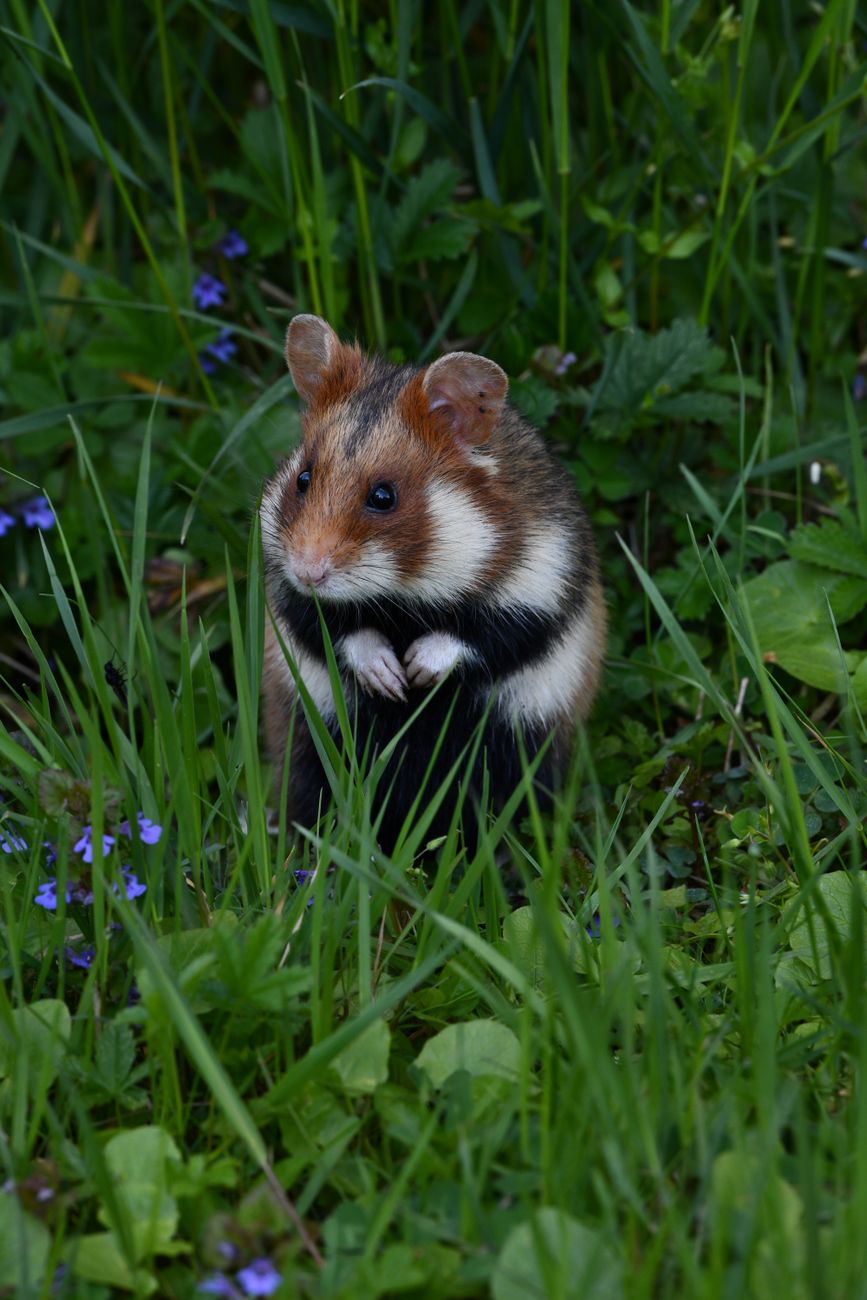
EUROPEAN HAMSTER
DESCRIPTION
Also called the Common Hamster, the European Hamster is a stout-bodied rodent with a short tail and large cheek pouches. It has a distinctive coloration, typically featuring a brownish or grayish coat with a lighter underbelly and black markings. This species is primarily nocturnal, exhibiting burrowing behavior and a tendency to hoard food for winter months, making it an important player in its ecosystem as a seed disperser.
FUN FACTS
- European Hamsters are known for their impressive cheek pouches, which they use to store food while foraging
- These pouches can expand significantly, allowing them to carry large amounts of seeds back to their burrows
- | Interestingly, European Hamsters have a unique hibernation pattern; they enter a state of torpor during the coldest months, waking periodically to consume their stored food
- This adaptation helps them survive in harsh winter conditions
QUICK INFO
Lifespan2-3 years in the wild, up to 4 years in captivity
Average Weight200-500 g
Average Length20-30 cm
Diet TypeHerbivore
Social StructureSolitary, with individuals maintaining their own territories.
Activity PatternNocturnal
Breeding SeasonSpring (March-May)
- Habitat
- European Hamsters inhabit agricultural fields, grasslands, and areas with dense vegetation. They create extensive burrow systems that provide shelter and storage for food.
- Biomes
- Temperate Grassland, Agricultural Land
- Native Range
- The native range of the European Hamster includes parts of Eastern and Central Europe, particularly in countries like France, Germany, and Poland.
- Continent
- Europe
- Countries
- France, Germany, Poland, Ukraine, Romania
- Diet
- The European Hamster primarily feeds on seeds, grains, and various plant materials. It may also consume some insects and small invertebrates.
- Diet Type
- Herbivore
- Favorite Food
- Seeds and grains
- Social Structure
- Solitary, with individuals maintaining their own territories.
- Activity Pattern
- Nocturnal
- Group Size
- 1
- Territorial
- 1

 VU
VU
 LC
LC
 LC
LC
200-500 g
Weight
20-30 cm
Length
- Coloration
- Brownish or grayish coat with a lighter underbelly and black markings
- Sexual Dimorphism
- Males are generally larger than females.
- Lifespan
- 2-3 years in the wild, up to 4 years in captivity
- Gestation Period
- 16-18 days
- Offspring per Birth
- 4-12
- Sexual Maturity
- 2-3 months
- Breeding Season
- Spring (March-May)
EN
Endangered
IUCN Red List Status
- Population Status
- The population of European Hamsters is declining due to habitat loss and agricultural practices.
- Wild Population Estimate
- Unknown, but populations are decreasing
- Population Trend
- Decreasing
- Endangered
- 1
- Threats
- Main threats include habitat destruction due to agricultural expansion and urbanization, as well as predation by domestic animals. These factors have led to significant declines in their populations.
- Conservation Program
- Various local conservation efforts are in place, but no large-scale programs are widely recognized.
- Predators
- Foxes, birds of prey, domestic cats, and weasels.
- Defense Mechanisms
- European Hamsters rely on their burrows for protection and can also use their strong teeth to defend themselves if threatened.
- Found in Zoos
- Uncommon