


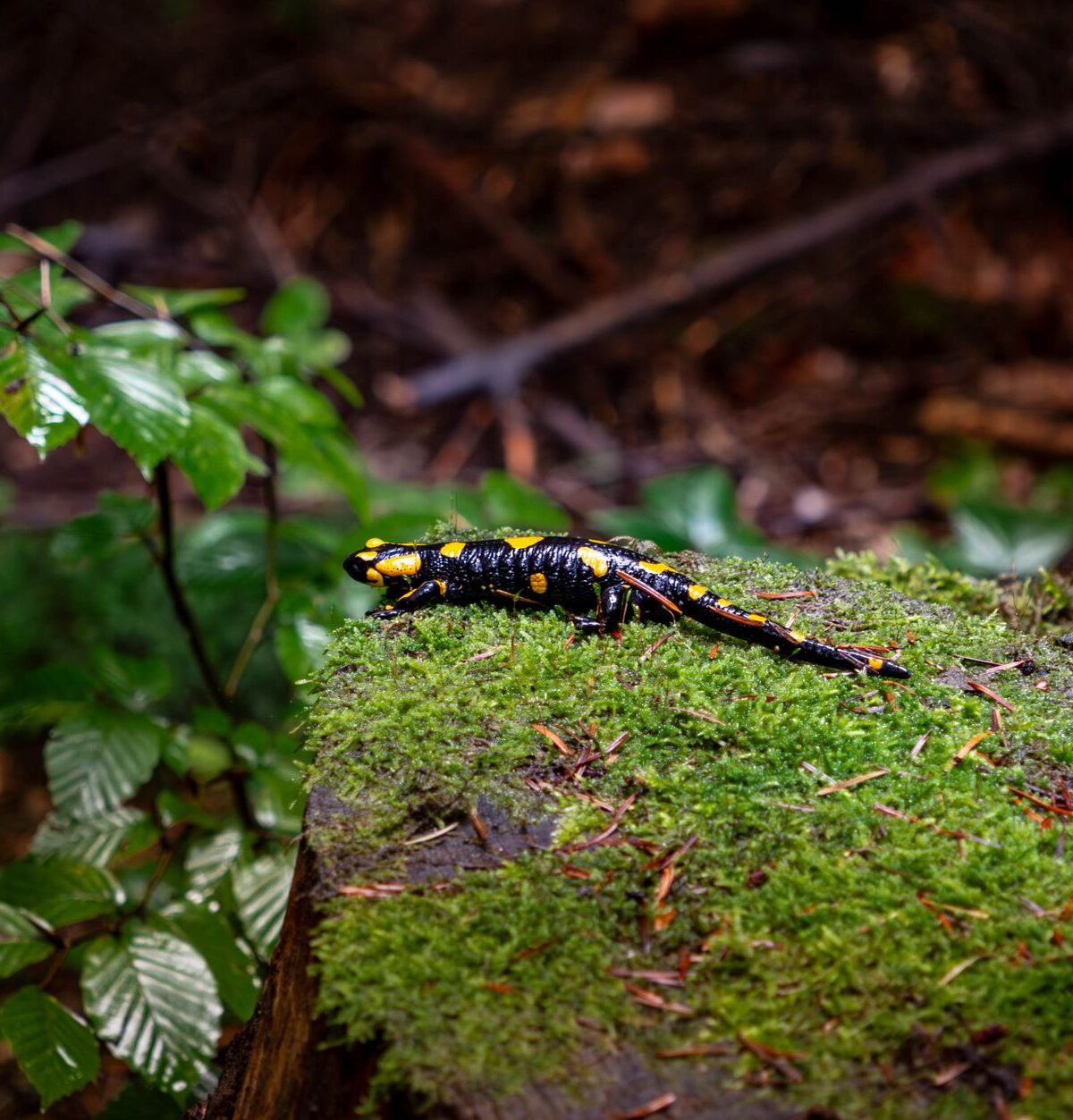
FIRE SALAMANDER
Salamandra salamandra
DESCRIPTION
Fire Salamander (Salamandra salamandra) is a striking amphibian known for its vibrant black body adorned with bright yellow or orange spots. This coloration serves as a warning to potential predators about its toxicity, which is derived from the secretion of glands in its skin. Typically found in moist, forested areas, Fire Salamanders are primarily nocturnal and are often seen during rainy nights when they are most active.
FUN FACTS
- Fire Salamanders are often associated with folklore and mythology, believed by some cultures to be able to withstand fire, which is reflected in their name
- In reality, they are completely aquatic and thrive in moist environments, making them vulnerable to drying out
- | These salamanders can regenerate lost limbs, a fascinating ability that has drawn the interest of scientists studying regeneration in vertebrates
- This regenerative capability is not only limited to limbs but can also extend to other body parts, showcasing their remarkable biological resilience
QUICK INFO
Lifespan10-20 years in the wild, up to 30 in captivity
Average Weight50-100 g
Average Length15-25 cm
Diet TypeInsectivore
Social Structuresolitary, typically found alone except during breeding
Activity PatternNocturnal
Breeding SeasonSpring (March-May)
- Habitat
- Fire Salamanders thrive in damp, wooded environments, often near streams or ponds where they can find suitable breeding sites. They require moist conditions to prevent dehydration, especially during their terrestrial phase.
- Biomes
- Temperate Forest, Montane Forest
- Native Range
- Fire Salamanders are native to a wide range across Europe, from the Iberian Peninsula to the Balkans and parts of Central Europe.
- Continent
- Europe
- Countries
- Spain, Portugal, France, Germany, Italy, Austria, Switzerland, Slovenia, Croatia, Hungary
- Diet
- Fire Salamanders primarily feed on a variety of invertebrates, including insects and worms. They are known to hunt by ambushing their prey, using their keen sense of smell to locate food.
- Diet Type
- Insectivore
- Favorite Food
- insects, worms
- Social Structure
- solitary, typically found alone except during breeding
- Activity Pattern
- Nocturnal
- Group Size
- 1-2
- Territorial
- 0
 VU
VU
 LC
LC

50-100 g
Weight
15-25 cm
Length
- Coloration
- black body with bright yellow or orange spots
- Sexual Dimorphism
- males are generally smaller and have more vibrant coloration than females
- Lifespan
- 10-20 years in the wild, up to 30 in captivity
- Offspring per Birth
- 20-30
- Sexual Maturity
- 2-3 years
- Breeding Season
- Spring (March-May)
LC
Least Concern
IUCN Red List Status
- Population Status
- The population of Fire Salamanders is currently stable in many areas, but they face threats from habitat loss and pollution.
- Wild Population Estimate
- unknown
- Population Trend
- Stable
- Endangered
- 0
- Threats
- Main threats include habitat destruction due to urbanization and agriculture, as well as pollution of their aquatic breeding sites. Climate change also poses a risk by altering their habitat conditions.
- Predators
- birds, snakes, small mammals, and larger amphibians
- Defense Mechanisms
- Fire Salamanders possess toxic skin secretions that deter predators, making them unpalatable.
- Found in Zoos
- Common