


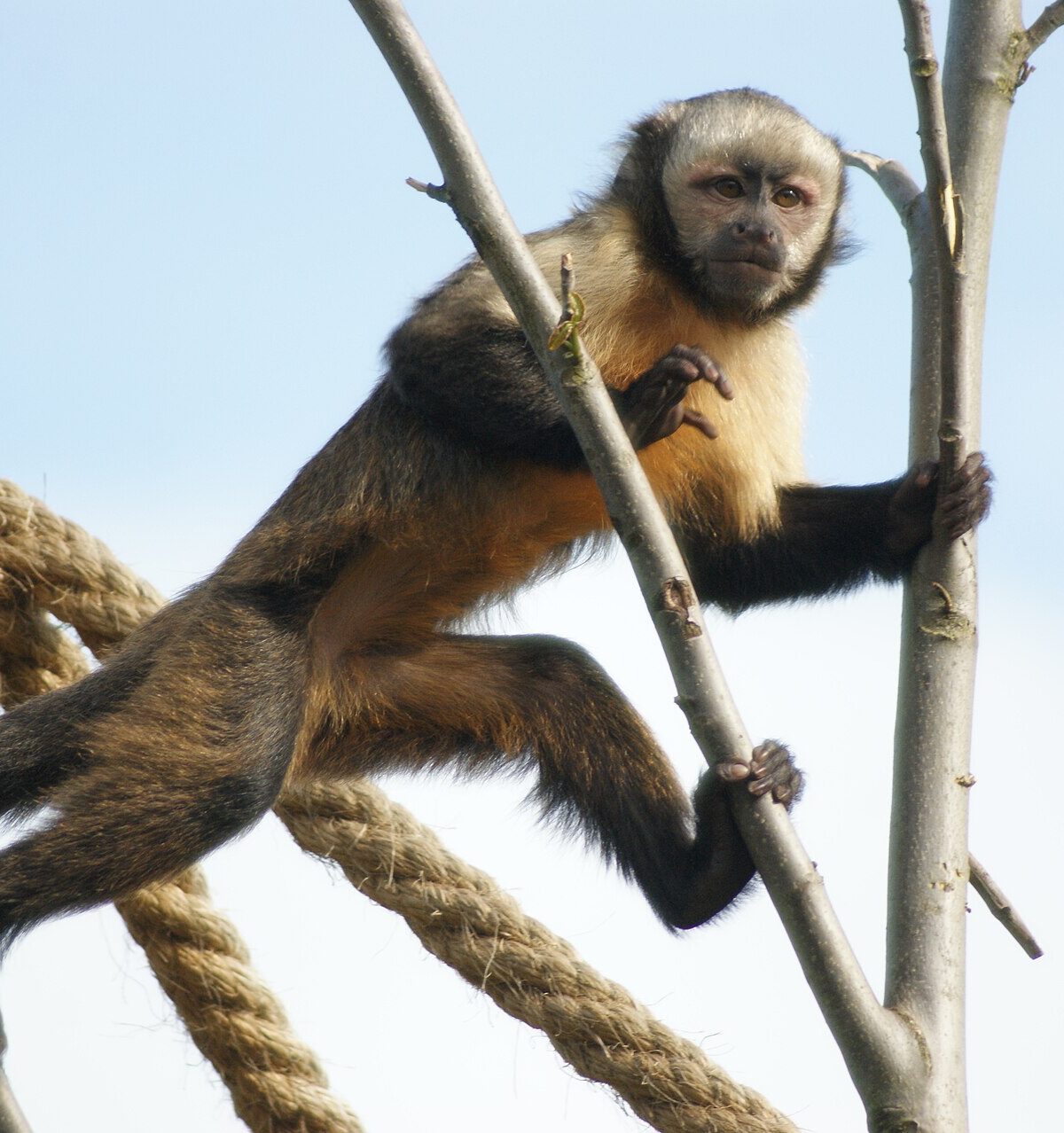
GOLDEN-BELLIED CAPUCHIN
DESCRIPTION
Also called the Golden-bellied Monkey, the Golden-bellied Capuchin is a medium-sized primate known for its distinctive golden fur on the belly and face, contrasting with darker fur on the rest of the body. These monkeys are highly intelligent and exhibit complex social behaviors, often using tools to access food. They are primarily arboreal, spending much of their time in trees, where they forage for fruits, seeds, and insects.
FUN FACTS
- Golden-bellied Capuchins are known for their remarkable intelligence, often demonstrating problem-solving skills that rival those of some great apes
- They have been observed using tools in the wild, such as using stones to crack open hard-shelled fruits, showcasing their ability to manipulate their environment
- | These monkeys have a complex social structure, with strong family bonds and intricate social hierarchies
- They engage in grooming behaviors that not only strengthen social ties but also help maintain hygiene within the group
QUICK INFO
Lifespan15-25 years in the wild, up to 30 years in captivi
Average Weight3-4 kg
Average Length40-55 cm
Diet TypeOmnivore
Social StructureThey live in groups, typically consisting of 10-30 individuals, which are characterized by strong social bonds and cooperative behaviors.
Activity PatternDiurnal
Breeding SeasonYear-round, with peaks depending on local conditions
- Habitat
- This species inhabits tropical and subtropical forests, often found in areas with dense canopy cover. They prefer regions with abundant food sources and suitable nesting sites.
- Biomes
- Tropical Rainforest, Subtropical Forest
- Native Range
- The Golden-bellied Capuchin is native to the eastern regions of South America, particularly in Brazil and parts of Bolivia.
- Continent
- South America
- Countries
- Brazil, Bolivia
- Diet
- The Golden-bellied Capuchin primarily eats fruits, seeds, and insects, showcasing a diverse diet that allows them to thrive in their natural habitat.
- Diet Type
- Omnivore
- Favorite Food
- fruits, seeds, insects
- Social Structure
- They live in groups, typically consisting of 10-30 individuals, which are characterized by strong social bonds and cooperative behaviors.
- Activity Pattern
- Diurnal
- Group Size
- 10-30
- Territorial
- 1
 VU
VU
 LC
LC
3-4 kg
Weight
40-55 cm
Length
- Coloration
- The fur is predominantly dark brown or black, with a distinctive golden or yellowish patch on the belly and face.
- Sexual Dimorphism
- Males are generally larger than females, with more pronounced musculature.
- Lifespan
- 15-25 years in the wild, up to 30 years in captivi
- Gestation Period
- 150-180 days
- Offspring per Birth
- 1-2
- Sexual Maturity
- 3-4 years
- Breeding Season
- Year-round, with peaks depending on local conditions
LC
Least Concern
IUCN Red List Status
- Population Status
- The population is currently stable, but habitat loss poses a potential threat.
- Wild Population Estimate
- Unknown, but considered stable
- Population Trend
- Stable
- Endangered
- 0
- Threats
- Main threats include habitat destruction due to deforestation and human encroachment. Additionally, they face risks from the illegal pet trade.
- Predators
- Large birds of prey, snakes, and felids such as jaguars may prey on young or vulnerable individuals.
- Defense Mechanisms
- They use vocalizations to alert the group of potential threats and can also flee to higher branches to escape predators.
- Compatible Animals
- Other capuchin species, small primates
- Found in Zoos
- Common