


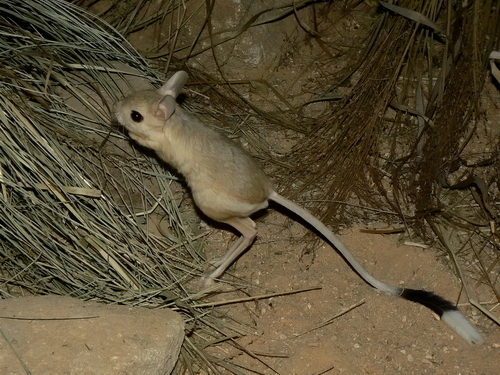
GREATER EGYPTIAN JERBOA
Jaculus orientalis
DESCRIPTION
The Greater Egyptian Jerboa (Jaculus orientalis) is a small, nocturnal rodent characterized by its long hind legs and short forelimbs, which enable it to make impressive leaps across the desert terrain. Its fur is typically sandy or light brown, providing excellent camouflage against the arid landscape. This species is well-adapted to its environment, exhibiting behaviors such as burrowing to escape the heat and foraging for food during the cooler night hours.
FUN FACTS
- The Greater Egyptian Jerboa can leap up to 3 meters in a single bound, making it one of the most agile rodents in the world
- Its unique adaptations allow it to thrive in some of the harshest environments on Earth, showcasing the incredible resilience of wildlife in extreme conditions.| Unlike many rodents, the Greater Egyptian Jerboa has a specialized diet that allows it to extract moisture from its food, reducing its need for water
- This adaptation is crucial for survival in the arid deserts where it lives
QUICK INFO
Lifespan3-5 years in the wild
Average Weight100-150 g
Average Length20-25 cm
Diet TypeHerbivore
Social Structuresolitary, typically found alone or in pairs during mating season
Activity PatternNocturnal
Breeding SeasonSpring (March-May)
- Habitat
- This species inhabits sandy deserts and semi-arid regions, where it can find ample cover and food sources. It often creates burrows to escape extreme temperatures and predators.
- Biomes
- Desert, Semi-arid
- Native Range
- The Greater Egyptian Jerboa is native to parts of North Africa and the Middle East.
- Continent
- Africa, Asia
- Countries
- Egypt, Libya, Sudan, Jordan, Saudi Arabia
- Diet
- The Greater Egyptian Jerboa primarily feeds on seeds, roots, and other plant materials. It has adapted to survive in arid conditions by obtaining moisture from its food.
- Diet Type
- Herbivore
- Favorite Food
- seeds and roots
- Social Structure
- solitary, typically found alone or in pairs during mating season
- Activity Pattern
- Nocturnal
- Group Size
- 1-2
- Territorial
- 0

 VU
VU
 LC
LC
100-150 g
Weight
20-25 cm
Length
- Coloration
- sandy or light brown fur
- Lifespan
- 3-5 years in the wild
- Gestation Period
- 30-35 days
- Offspring per Birth
- 2-4
- Sexual Maturity
- 2-3 months
- Breeding Season
- Spring (March-May)
LC
Least Concern
IUCN Red List Status
- Population Status
- The population status is currently stable, but habitat loss poses a potential threat.
- Wild Population Estimate
- unknown
- Population Trend
- Stable
- Endangered
- 0
- Threats
- Main threats include habitat destruction due to agricultural expansion and urban development. Additionally, climate change may impact their arid habitats.
- Predators
- foxes, birds of prey, snakes
- Defense Mechanisms
- The Greater Egyptian Jerboa uses its speed and agility to escape predators, often making quick, long jumps to evade capture.
- Found in Zoos
- Rare