


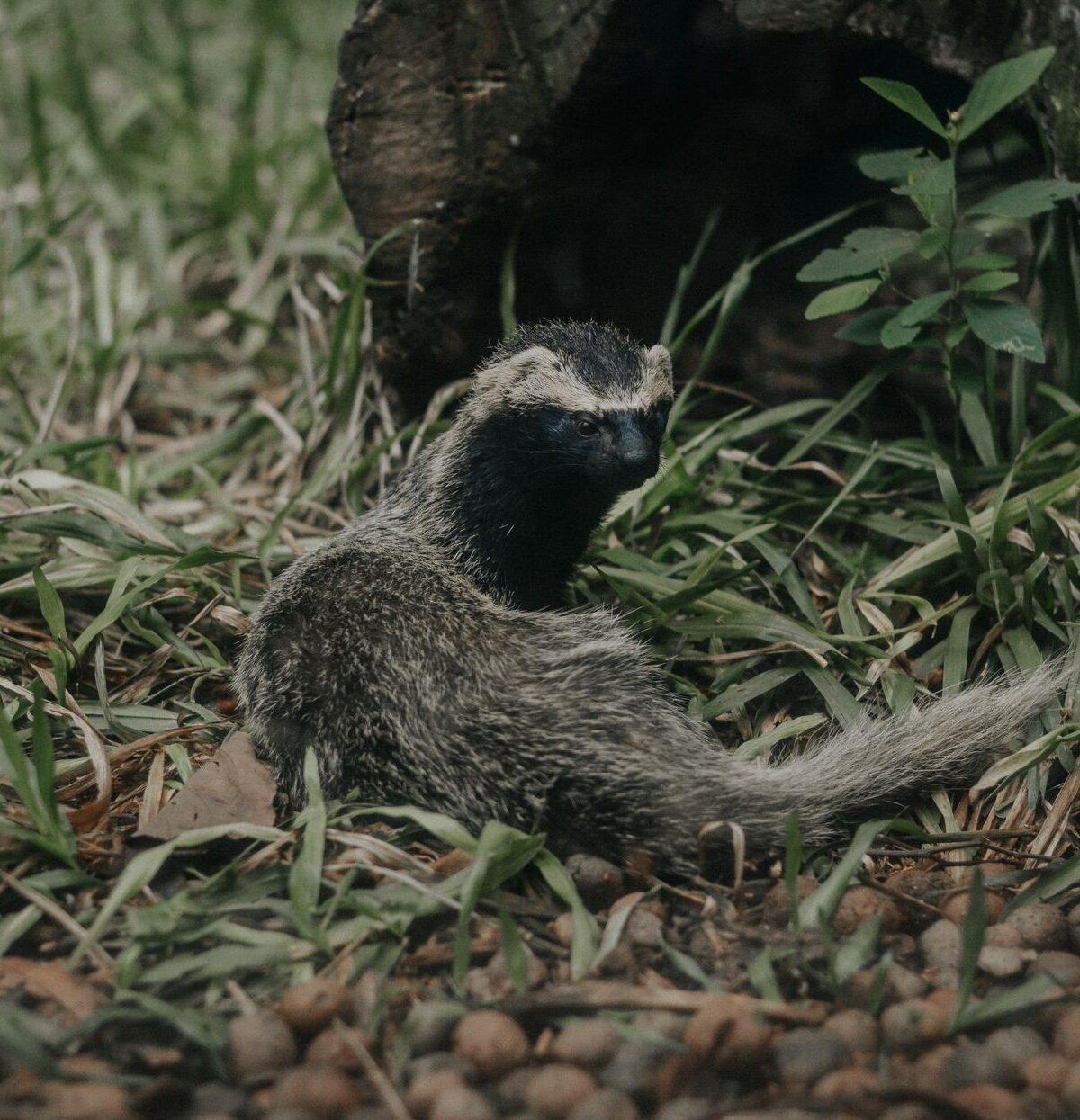
GREATER GRISON
Galictis vittata
DESCRIPTION
Greater Grison (Galictis vittata) is commonly known as Grison. This medium-sized carnivore has a distinctive appearance, characterized by its long body, short legs, and a bushy tail. It has a dark brown to grayish fur with lighter underparts and a unique facial pattern, making it easily recognizable in its natural habitat.
FUN FACTS
- Greater Grisons are known for their intelligence and problem-solving abilities, often using tools to access food
- They have a unique social structure, where males may help care for the young, showcasing a level of parental investment not commonly seen in mustelids
QUICK INFO
Lifespan8-10 years in the wild, up to 15 years in captivit
Average Weight5-10 kg
Average Length60-80 cm
Diet TypeCarnivore
Social Structuresolitary, occasionally forming pairs during breeding
Activity PatternDiurnal
Breeding SeasonYear-round, peaking in wet season
- Habitat
- Greater Grisons inhabit a variety of environments, including forests, grasslands, and scrublands. They prefer areas with dense vegetation that provide cover for hunting and nesting.
- Biomes
- Temperate Forest, Grassland, Savanna
- Native Range
- They are native to Central and South America, ranging from southern Mexico to northern Argentina.
- Continent
- North America, South America
- Countries
- Mexico, Guatemala, Honduras, Nicaragua, Costa Rica, Panama, Colombia, Venezuela, Ecuador, Peru, Brazil, Bolivia, Paraguay, Argentina
- Diet
- Greater Grisons primarily feed on small mammals, birds, and insects, showcasing their adaptability in hunting. They are known to scavenge as well, taking advantage of available food sources.
- Diet Type
- Carnivore
- Favorite Food
- small mammals, birds, insects
- Social Structure
- solitary, occasionally forming pairs during breeding
- Activity Pattern
- Diurnal
- Group Size
- 1-2
- Territorial
- 1
 VU
VU
 NT
NT

5-10 kg
Weight
60-80 cm
Length
- Coloration
- dark brown to grayish fur with lighter underparts
- Sexual Dimorphism
- males are generally larger than females
- Lifespan
- 8-10 years in the wild, up to 15 years in captivit
- Gestation Period
- 60-70 days
- Offspring per Birth
- 2-4
- Sexual Maturity
- 1-2 years
- Breeding Season
- Year-round, peaking in wet season
LC
Least Concern
IUCN Red List Status
- Population Status
- The population is currently stable, but habitat loss poses a potential threat.
- Wild Population Estimate
- Unknown
- Population Trend
- Stable
- Endangered
- 0
- Threats
- Main threats include habitat destruction due to agriculture and urbanization. Additionally, they face risks from hunting and trapping.
- Predators
- large birds of prey, jaguars, pumas
- Defense Mechanisms
- They can emit a strong-smelling secretion from their anal glands to deter predators.
- Found in Zoos
- Uncommon