


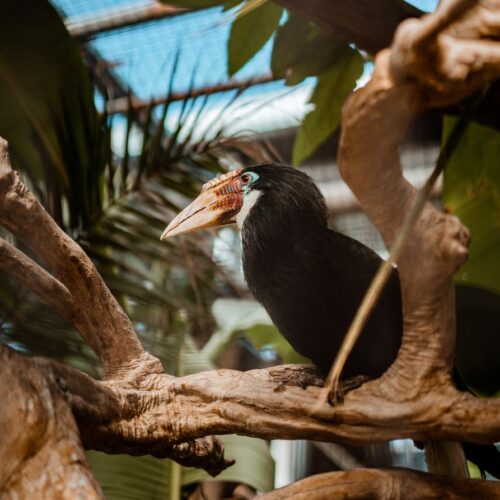
HORNBILL
DESCRIPTION
Hornbills are distinctive birds known for their long, curved bills and unique nesting behavior. They are found primarily in tropical and subtropical regions of Africa and Asia.
FUN FACTS
- Hornbills are known for their unique nesting behavior where the female seals herself in a tree cavity | They play a vital role in their ecosystems as seed dispersers | Some species can live for over 40 years in captivity
QUICK INFO
Lifespan20-30 years in the wild, up to 40 in captivity
Average Weight0.5-4 kg
Average Length0.6-1.2 m
Diet TypeOmnivore
Social Structurepair, often monogamous and can be seen foraging together
Activity PatternDiurnal
Breeding SeasonVaries by region, often during the rainy season
- Habitat
- Hornbills inhabit a range of environments including forests, savannas, and woodlands. They prefer areas with abundant fruiting trees.
- Biomes
- Tropical Rainforest, Savanna, Woodland
- Native Range
- Hornbills are native to Africa, Asia, and parts of the Indian subcontinent.
- Continent
- Africa, Asia
- Countries
- India, Thailand, Indonesia, Kenya, Uganda
- Diet
- Hornbills are omnivorous, feeding on a variety of fruits, insects, and small animals. They play a crucial role in seed dispersal in their ecosystems.
- Diet Type
- Omnivore
- Favorite Food
- Fruits, insects, small vertebrates
- Social Structure
- pair, often monogamous and can be seen foraging together
- Activity Pattern
- Diurnal
- Group Size
- 2-6
- Territorial
- 1
 VU
VU
 LC
LC
 LC
LC
0.5-4 kg
Weight
0.6-1.2 m
Length
- Coloration
- Typically black and white with bright yellow, orange, or red bill coloration.
- Sexual Dimorphism
- Males and females differ in size and bill coloration, with males generally having larger bills.
- Lifespan
- 20-30 years in the wild, up to 40 in captivity
- Offspring per Birth
- 2-4
- Sexual Maturity
- 3-5 years
- Breeding Season
- Varies by region, often during the rainy season
VU
Vulnerable
IUCN Red List Status
- Population Status
- Some species are common, while others are threatened due to habitat loss.
- Wild Population Estimate
- Unknown, varies by species
- Population Trend
- Decreasing
- Endangered
- 1
- Threats
- Habitat destruction and hunting are the main threats to hornbill populations. Deforestation significantly impacts their nesting sites.
- Predators
- Large birds of prey, snakes, and mammals may prey on hornbill eggs and chicks.
- Defense Mechanisms
- Hornbills use their large bills for defense and can be aggressive when threatened.
- Found in Zoos
- Uncommon