


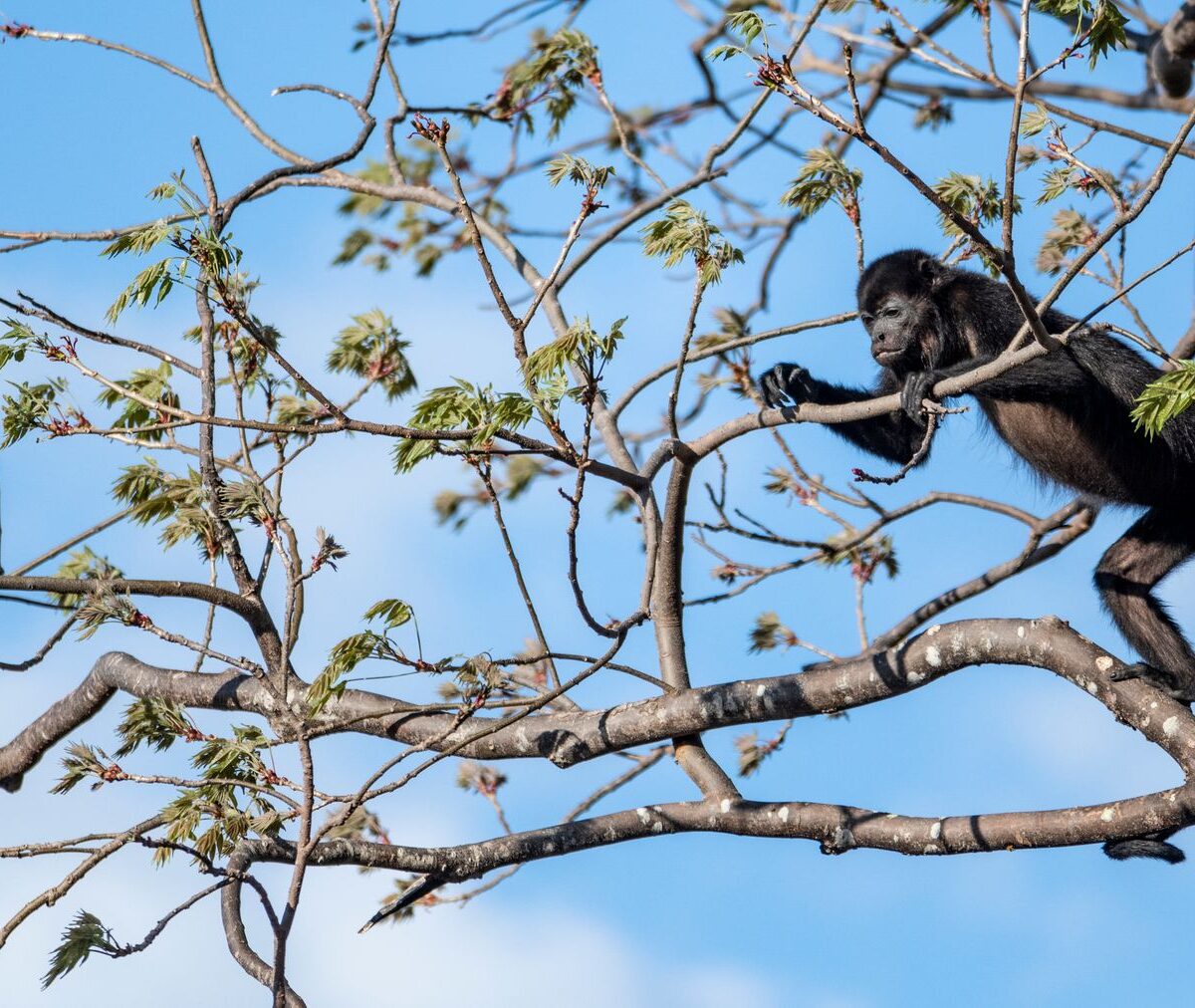
HOWLER MONKEY
DESCRIPTION
Howler Monkeys, also known as Black Howler, Mantled Howler, and Red Howler, are notable for their distinctive vocalizations, which can be heard over long distances. They possess a robust body, long limbs, and a prehensile tail that aids in their arboreal lifestyle. Their fur varies in color from black to brown or red, depending on the species, and they are primarily found in the treetops of tropical forests.
FUN FACTS
- Howler Monkeys are among the loudest land animals, with their howls capable of reaching up to 90 decibels, which is comparable to a chainsaw
- Their vocalizations serve not only to communicate with their group but also to deter other animals from entering their territory
- | These monkeys have a unique adaptation in their throat, which contains an enlarged hyoid bone that acts as a resonating chamber, amplifying their calls
- This adaptation allows them to communicate effectively over long distances in dense forests
QUICK INFO
Lifespan15-20 years in the wild, up to 25 years in captivi
Average Weight6-10 kg
Average Length50-70 cm
Diet TypeHerbivore
Social Structuregroup — they typically live in small to medium-sized groups consisting of several individuals, often led by a dominant male.
Activity PatternDiurnal
Breeding SeasonYear-round, with peaks depending on the species and location
- Habitat
- Howler Monkeys inhabit tropical rainforests and deciduous forests, often preferring areas with abundant foliage. They are highly arboreal, spending most of their time in the trees.
- Biomes
- Tropical Rainforest, Deciduous Forest
- Native Range
- Howler Monkeys are native to Central and South America, ranging from Mexico to Argentina.
- Continent
- North America, South America
- Countries
- Mexico, Belize, Guatemala, Honduras, Nicaragua, Costa Rica, Panama, Colombia, Venezuela, Ecuador, Peru, Brazil, Bolivia, Paraguay, Argentina
- Diet
- Howler Monkeys are primarily folivorous, feeding mainly on leaves, fruits, and flowers. Their specialized digestive system allows them to extract nutrients from tough plant material.
- Diet Type
- Herbivore
- Favorite Food
- leaves, fruits, flowers
- Social Structure
- group — they typically live in small to medium-sized groups consisting of several individuals, often led by a dominant male.
- Activity Pattern
- Diurnal
- Group Size
- 5-15
- Territorial
- 1
 VU
VU
 NT
NT
6-10 kg
Weight
50-70 cm
Length
- Coloration
- fur color varies from black to brown or red, depending on the species
- Sexual Dimorphism
- males are generally larger than females
- Lifespan
- 15-20 years in the wild, up to 25 years in captivi
- Gestation Period
- 180 days
- Offspring per Birth
- 1
- Sexual Maturity
- 2-3 years
- Breeding Season
- Year-round, with peaks depending on the species and location
VU
Vulnerable
IUCN Red List Status
- Population Status
- Some species of Howler Monkeys are experiencing population declines due to habitat loss and hunting.
- Wild Population Estimate
- 50,000-100,000
- Population Trend
- Decreasing
- Endangered
- 1
- Threats
- Main threats include deforestation, habitat fragmentation, and hunting. These factors have led to significant declines in their populations across various regions.
- Conservation Program
- Various conservation programs are in place to protect their habitats and raise awareness about their ecological importance.
- Predators
- Large birds of prey, jaguars, and snakes are known to prey on Howler Monkeys, particularly the young and weaker individuals.
- Defense Mechanisms
- Howler Monkeys use their loud vocalizations to warn off potential threats and establish territory.
- Compatible Animals
- Spider Monkeys, Capuchin Monkeys
- Found in Zoos
- Common