


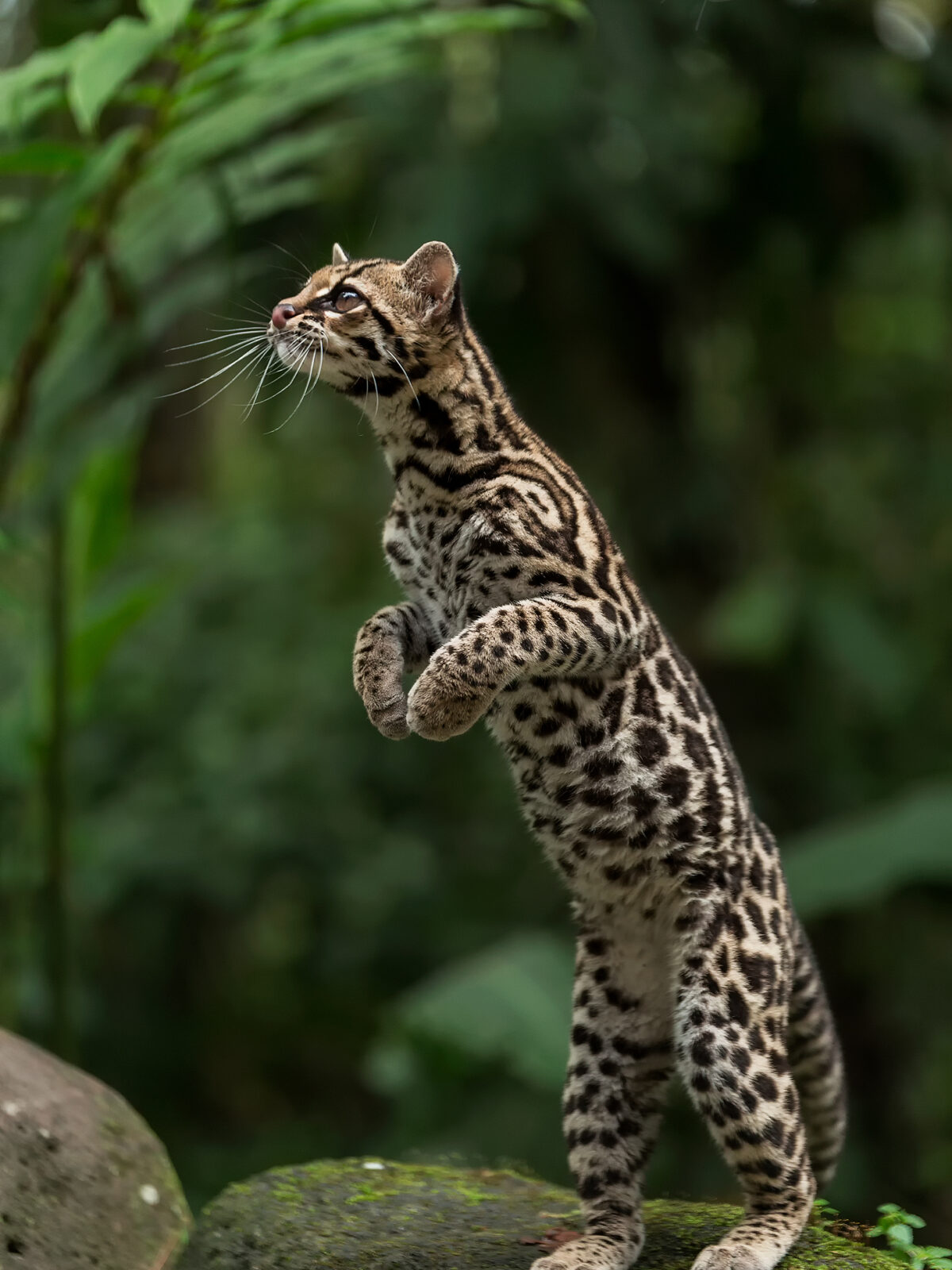
MARGAY
Leopardus wiedii
DESCRIPTION
The Margay (Leopardus wiedii) is a small wild cat native to Central and South America, known for its striking resemblance to the ocelot. It has a slender body, long legs, and a long tail, which aids in balance as it navigates through the trees. Margays are highly arboreal, spending much of their time in the canopy, and are known for their remarkable agility and ability to leap between branches.
FUN FACTS
- Margays are known for their unique ability to mimic the calls of their prey, which helps them lure in birds and small mammals
- This vocal mimicry is a rare trait among felids and showcases their intelligence and adaptability
- | Unlike many other cats, Margays have flexible ankle joints that allow them to climb down trees headfirst, making them exceptional climbers
- This adaptation is crucial for their survival in the dense forests where they live, as it enables them to escape threats and hunt effectively
QUICK INFO
Lifespan10-12 years in the wild, up to 20 years in captivi
Average Weight8-15 lbs
Average Length18-30 inches
Diet TypeCarnivore
Social Structuresolitary, with individuals maintaining their own territories
Activity PatternNocturnal
Breeding SeasonYear-round, with peaks depending on the region
- Habitat
- Margays inhabit tropical and subtropical forests, often favoring areas with dense vegetation. They are also found in secondary forests and sometimes in more open habitats, but they require cover for hunting.
- Biomes
- Tropical Rainforest, Subtropical Forest
- Native Range
- The Margay is found from southern Mexico through Central America and into South America, as far south as northern Argentina and Uruguay.
- Continent
- North America, South America
- Countries
- Mexico, Guatemala, Honduras, Nicaragua, Costa Rica, Panama, Colombia, Venezuela, Ecuador, Peru, Brazil, Bolivia, Paraguay, Argentina, Uruguay
- Diet
- Margays primarily feed on small mammals, birds, and reptiles. They are skilled hunters, using stealth and agility to catch their prey.
- Diet Type
- Carnivore
- Favorite Food
- small mammals, birds
- Social Structure
- solitary, with individuals maintaining their own territories
- Activity Pattern
- Nocturnal
- Group Size
- 1
- Territorial
- 1
8-15 lbs
Weight
18-30 inches
Length
- Coloration
- The Margay has a coat that is yellowish-tan with black rosettes and spots, providing excellent camouflage in its forest habitat.
- Sexual Dimorphism
- Females are generally smaller than males.
- Lifespan
- 10-12 years in the wild, up to 20 years in captivi
- Gestation Period
- 70-75 days
- Offspring per Birth
- 1-3
- Sexual Maturity
- 2-3 years
- Breeding Season
- Year-round, with peaks depending on the region
NT
Near Threatened
IUCN Red List Status
- Population Status
- The Margay population is currently considered to be decreasing due to habitat loss and hunting.
- Wild Population Estimate
- Unknown, but believed to be declining
- Population Trend
- Decreasing
- Endangered
- 1
- Threats
- Main threats to the Margay include habitat destruction due to deforestation and fragmentation, as well as poaching for the illegal pet trade. These factors have led to a decline in their populations across their range.
- Predators
- Larger cats such as jaguars and pumas may prey on Margays, along with birds of prey and humans.
- Defense Mechanisms
- Margays rely on their agility and climbing skills to escape predators, often retreating to the safety of trees.
- Found in Zoos
- Uncommon