


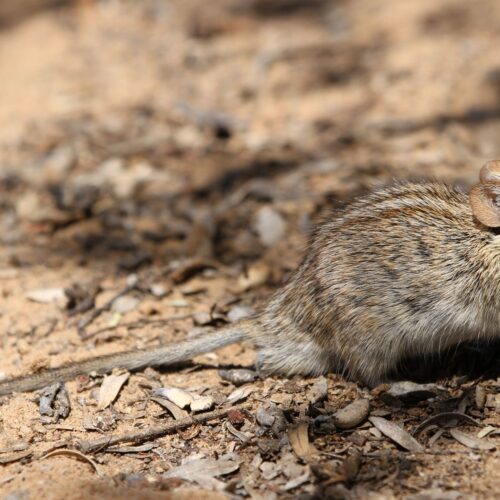
MOUSE
Mus musculus
DESCRIPTION
The house mouse (Mus musculus) is a small rodent that is commonly found in human habitats. It is known for its adaptability and ability to thrive in various environments.
FUN FACTS
- House mice can reproduce quickly, with a female capable of having up to 10 litters a year | They have excellent hearing and can detect high-frequency sounds | Mice are known to be very curious and will explore their surroundings extensively
QUICK INFO
Lifespan1-2 years in the wild, up to 3 years in captivity
Average Weight20-30 g
Average Length7.5-10 cm
Diet TypeOmnivore
Social StructureGroup — they often live in colonies with a social hierarchy.
Activity PatternNocturnal
Breeding SeasonYear-round, with peaks in spring and summer
- Habitat
- House mice are often found in urban areas, fields, and forests. They prefer environments that provide shelter and food sources.
- Biomes
- Urban, Grassland, Forest
- Native Range
- Originally native to Central Asia, house mice have spread globally due to human activity.
- Continent
- Asia, Europe, North America, Australia
- Countries
- Worldwide
- Diet
- Mice are omnivorous and consume a wide variety of foods, including grains, fruits, and seeds. They are known to scavenge for food in human dwellings.
- Diet Type
- Omnivore
- Favorite Food
- grains, seeds, fruits
- Social Structure
- Group — they often live in colonies with a social hierarchy.
- Activity Pattern
- Nocturnal
- Group Size
- 5-10
- Territorial
- 0

 VU
VU
 LC
LC
20-30 g
Weight
7.5-10 cm
Length
- Coloration
- Typically light brown to gray with a lighter underbelly.
- Sexual Dimorphism
- Males are generally larger than females.
- Lifespan
- 1-2 years in the wild, up to 3 years in captivity
- Gestation Period
- 19-21 days
- Offspring per Birth
- 3-14
- Sexual Maturity
- 6-8 weeks
- Breeding Season
- Year-round, with peaks in spring and summer
LC
Least Concern
IUCN Red List Status
- Population Status
- House mice are abundant and widespread, with large populations in many areas.
- Wild Population Estimate
- Unknown
- Population Trend
- Stable
- Endangered
- 0
- Threats
- House mice face threats from habitat destruction and predation. However, they are highly adaptable and resilient.
- Predators
- Cats, birds of prey, snakes
- Defense Mechanisms
- Mice use their agility and speed to escape predators, and they can also hide in small spaces.
- Compatible Animals
- Rats, gerbils, hamsters
- Found in Zoos
- Rare