


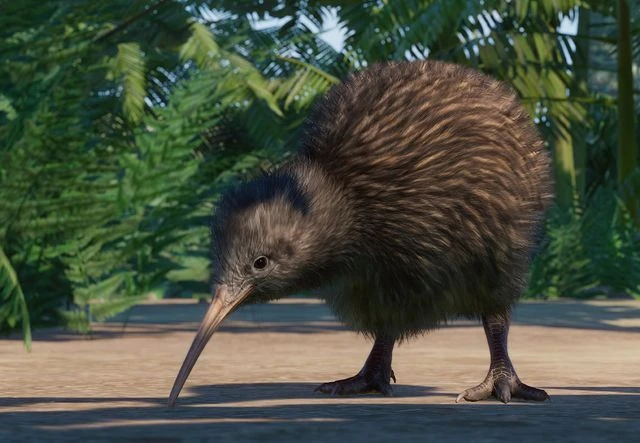
NORTH ISLAND BROWN KIWI
DESCRIPTION
Also called Kiwi and Kiwi Bird, the North Island Brown Kiwi is a flightless bird native to New Zealand. It has a distinctive long beak and a round body covered in brown, hair-like feathers that provide excellent camouflage in its forest habitat. This nocturnal bird is known for its unique foraging behavior, using its sensitive nostrils to probe the ground for insects and worms.
FUN FACTS
- The North Island Brown Kiwi is unique among birds for its highly developed sense of smell, which it uses to locate food underground
- Unlike most birds, kiwis have nostrils at the end of their long beaks, allowing them to sniff out insects and worms with remarkable accuracy.|Kiwis are also known for their unusual reproductive behavior; the female lays one of the largest eggs in relation to her body size of any bird species
- The male incubates the egg, which can weigh up to a quarter of the female's weight, for about 75-80 days
QUICK INFO
Lifespan25-50 years in the wild
Average Weight1.5-3.3 kg
Average Length40-50 cm
Diet TypeOmnivore
Social Structuresolitary, pairs during breeding season
Activity PatternNocturnal
Breeding SeasonSpring (August-December)
- Habitat
- The North Island Brown Kiwi inhabits a variety of forested areas, including both native and exotic forests. It prefers dense undergrowth where it can forage for food and hide from predators.
- Biomes
- Temperate Forest, Grassland
- Native Range
- North Island of New Zealand
- Continent
- Oceania
- Countries
- New Zealand
- Diet
- The North Island Brown Kiwi primarily feeds on invertebrates, seeds, and fruits found in the forest floor. It uses its long beak to search for food in the soil and leaf litter.
- Diet Type
- Omnivore
- Favorite Food
- insects, worms, fruits
- Social Structure
- solitary, pairs during breeding season
- Activity Pattern
- Nocturnal
- Group Size
- 1-2
- Territorial
- 1

 LC
LC
1.5-3.3 kg
Weight
40-50 cm
Length
- Coloration
- brown, hair-like feathers
- Sexual Dimorphism
- males are generally smaller than females
- Lifespan
- 25-50 years in the wild
- Offspring per Birth
- 1-2
- Sexual Maturity
- 1-2 years
- Breeding Season
- Spring (August-December)
EN
Endangered
IUCN Red List Status
- Population Status
- The population of North Island Brown Kiwi is currently declining due to habitat loss and predation.
- Wild Population Estimate
- 20,000-30,000
- Population Trend
- Decreasing
- Endangered
- 1
- Threats
- Main threats include habitat destruction and predation by introduced species such as dogs, cats, and stoats. Conservation efforts are ongoing to protect their habitats and control predator populations.
- Conservation Program
- Kiwi Recovery Program
- Predators
- dogs, cats, stoats, ferrets, rats
- Defense Mechanisms
- The North Island Brown Kiwi relies on its camouflage and nocturnal habits to avoid predators, rather than physical defenses.
- Found in Zoos
- Uncommon