


NORTHERN EAGLE OWL
Bubo bubo sibiricus
DESCRIPTION
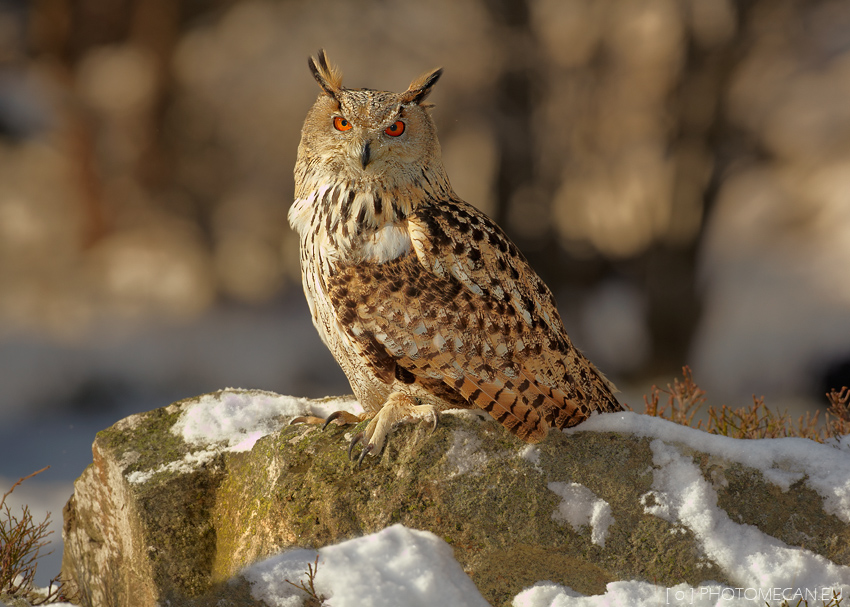
Northern eagle owl (Bubo bubo sibiricus) is a large and powerful bird of prey, known for its striking appearance and impressive size. It features prominent ear tufts, bright orange eyes, and a mottled brown and cream plumage that provides excellent camouflage in its natural habitat. This subspecies is primarily nocturnal, exhibiting a solitary behavior, and is known for its deep, resonant hoots that can be heard over long distances.
FUN FACTS
- Northern eagle owls are among the largest owl species in the world, with wingspans that can exceed 1.5 meters
- They are also known for their exceptional hunting skills, capable of taking down prey much larger than themselves, including young deer.| These owls have a unique ability to rotate their heads up to 270 degrees, allowing them to survey their surroundings without moving their bodies
- This adaptation is crucial for spotting potential prey and avoiding predators
QUICK INFO
Lifespan15-20 years in the wild, up to 30 in captivity
Average Weight2.5-4.5 kg
Average Length60-75 cm
Diet TypeCarnivore
Social StructureSolitary, with pairs forming during the breeding season.
Activity PatternNocturnal
Breeding SeasonSpring (March-May)
- Habitat
- These owls inhabit a variety of environments, including forests, mountains, and open landscapes, often favoring areas with dense cover for nesting. They require large territories to support their hunting needs.
- Biomes
- Temperate Forest, Taiga, Grassland
- Native Range
- The native range of the Northern eagle owl extends across parts of Siberia and northern Asia, including regions of Mongolia and Kazakhstan.
- Continent
- Asia
- Countries
- Russia, Mongolia, Kazakhstan
- Diet
- Northern eagle owls primarily feed on small to medium-sized mammals and birds, utilizing their keen eyesight and silent flight to hunt effectively at night.
- Diet Type
- Carnivore
- Favorite Food
- Rabbits, rodents, and birds
- Social Structure
- Solitary, with pairs forming during the breeding season.
- Activity Pattern
- Nocturnal
- Group Size
- 1-2
- Territorial
- 1
2.5-4.5 kg
Weight
60-75 cm
Length
- Coloration
- Mottled brown and cream with darker streaks and spots
- Sexual Dimorphism
- Females are generally larger than males.
- Lifespan
- 15-20 years in the wild, up to 30 in captivity
- Offspring per Birth
- 1-4
- Sexual Maturity
- 2-3 years
- Breeding Season
- Spring (March-May)
LC
Least Concern
IUCN Red List Status
- Population Status
- The population of Northern eagle owls is currently stable, though local declines may occur due to habitat loss.
- Wild Population Estimate
- Unknown
- Population Trend
- Stable
- Endangered
- 0
- Threats
- Main threats include habitat destruction due to logging and urban development, as well as hunting in some regions. Additionally, climate change may impact their prey availability.
- Predators
- Humans, larger birds of prey, and possibly wolves in some areas.
- Defense Mechanisms
- They rely on their camouflage and silent flight to avoid detection, and will also use aggressive displays if threatened.
- Found in Zoos
- Uncommon