


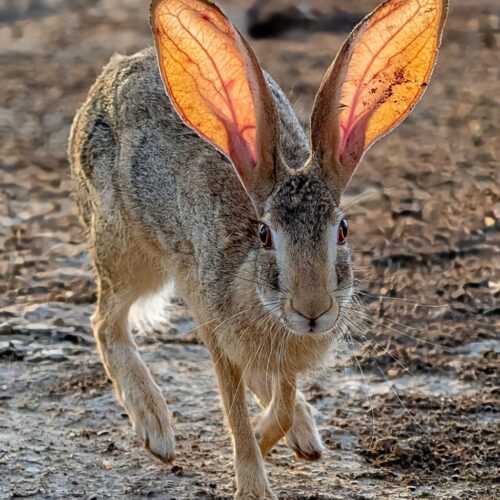
RABBITS
DESCRIPTION
Rabbits are small to medium-sized mammals known for their long ears, short fluffy tails, and strong hind legs. They have a distinctive appearance with large front teeth that continuously grow throughout their lives. Social and often found in groups, rabbits exhibit a range of behaviors including burrowing and foraging, which play a crucial role in their ecology as prey for various predators.
FUN FACTS
- Rabbits can jump up to three feet high and can run at speeds of up to 45 miles per hour, making them incredibly agile animals
- They also have a unique digestive system that allows them to extract nutrients from their food efficiently, which is why they often eat their own feces to maximize nutrient absorption.|Rabbits have a special adaptation in their teeth; their incisors grow continuously throughout their lives, which is necessary for their herbivorous diet
- This means they must constantly gnaw on fibrous materials to keep their teeth from growing too long
QUICK INFO
Lifespan5-10 years in the wild, up to 12 years in captivit
Average Weight1.5-2.5 kg
Average Length30-50 cm
Diet TypeHerbivore
Social Structuregroup — rabbits often live in colonies consisting of several individuals.
Activity PatternCrepuscular
Breeding SeasonSpring to early summer
- Habitat
- Rabbits typically inhabit meadows, forests, grasslands, and wetlands. They create burrows or nests in the ground for shelter and protection from predators.
- Biomes
- Grassland, Forest, Wetland
- Native Range
- Rabbits are native to Europe and North America, but they have been introduced to many other regions around the world.
- Continent
- North America, Europe, Asia, Africa
- Countries
- United States, Canada, United Kingdom, Australia, France
- Diet
- Rabbits are herbivores, primarily consuming grasses, leaves, and vegetables. Their diet is high in fiber, which is essential for their digestive health.
- Diet Type
- Herbivore
- Favorite Food
- grasses, clover, vegetables
- Social Structure
- group — rabbits often live in colonies consisting of several individuals.
- Activity Pattern
- Crepuscular
- Group Size
- 5-30
- Territorial
- 0
 CR
CR
 LC
LC
 LC
LC
 LC
LC
1.5-2.5 kg
Weight
30-50 cm
Length
- Coloration
- fur can vary from brown, gray, to white, often with a mix of colors.
- Sexual Dimorphism
- males are generally larger than females.
- Lifespan
- 5-10 years in the wild, up to 12 years in captivit
- Gestation Period
- 30-33 days
- Offspring per Birth
- 3-12
- Sexual Maturity
- 3-6 months
- Breeding Season
- Spring to early summer
LC
Least Concern
IUCN Red List Status
- Population Status
- Rabbits are widespread and generally have stable populations, although some species are threatened.
- Wild Population Estimate
- unknown
- Population Trend
- Stable
- Endangered
- 0
- Threats
- Main threats include habitat loss, predation, and disease. In some areas, they are also affected by hunting and competition with invasive species.
- Predators
- foxes, hawks, eagles, snakes, domestic cats, and dogs
- Defense Mechanisms
- Rabbits rely on their speed and agility to escape predators, often using zigzag patterns to evade capture.
- Compatible Animals
- guinea pigs, other rabbits, certain birds
- Found in Zoos
- Common