


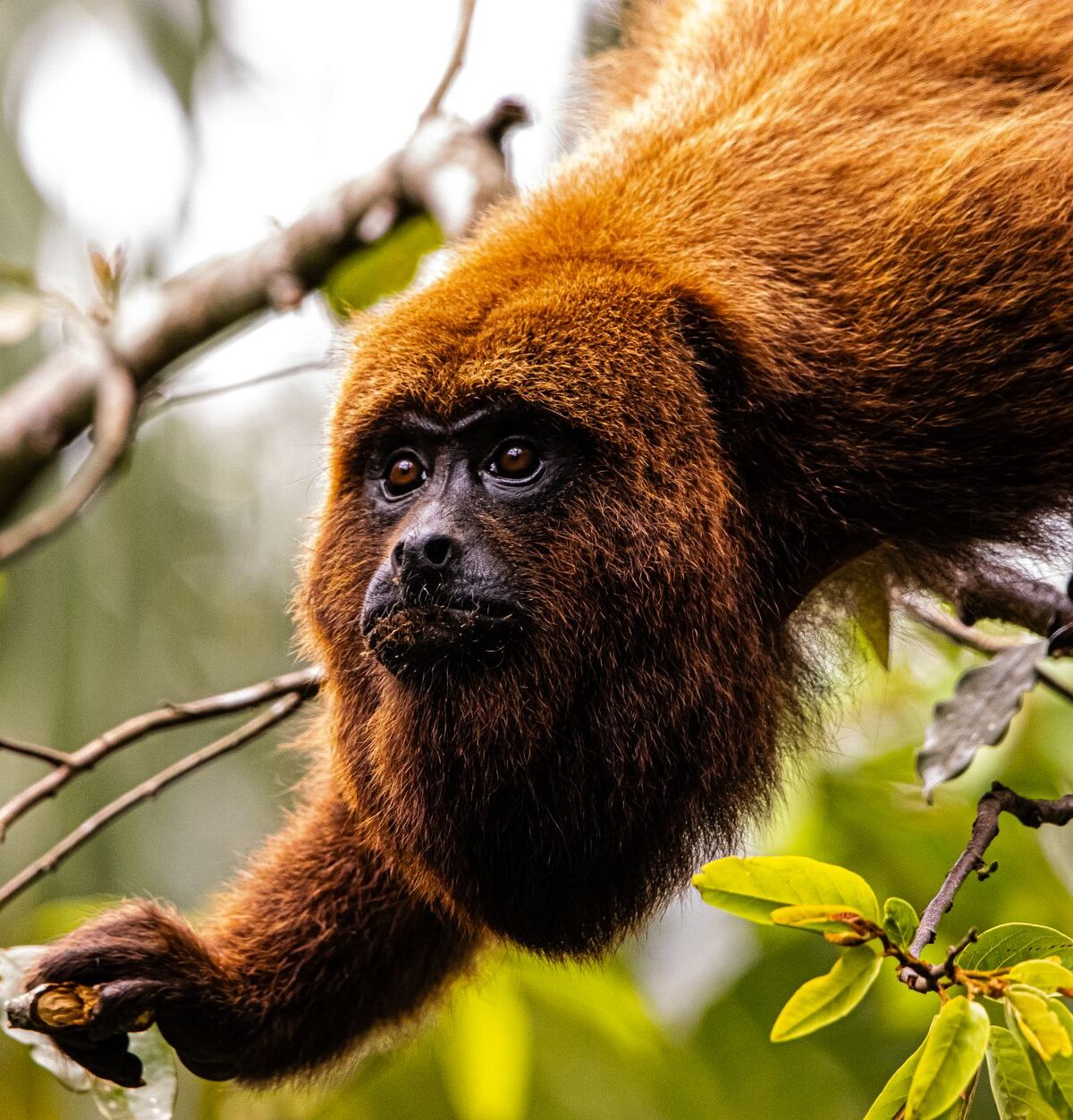
RED HOWLER MONKEY
Alouatta seniculus
DESCRIPTION
Red Howler Monkey (Alouatta seniculus) is a large primate known for its distinctive reddish-brown fur and long, prehensile tail. These monkeys are famous for their loud howling calls, which can be heard over long distances, serving as a means of communication among group members. They are primarily arboreal, spending most of their time in the trees of tropical rainforests, where they play a crucial role in seed dispersal and maintaining the health of their ecosystem.
FUN FACTS
- Red Howler Monkeys have a unique vocal sac that allows them to produce their characteristic howling calls, which can be heard up to three miles away in dense forest
- This vocalization is not only a means of communication but also serves to establish territory among neighboring groups
- | These monkeys have a highly developed sense of smell, which they use to locate food and communicate with other members of their group
- Their prehensile tails are incredibly strong and act as a fifth limb, allowing them to navigate the treetops with ease
QUICK INFO
Lifespan15-20 years in the wild, up to 25 in captivity
Average Weight6-10 kg
Average Length50-70 cm
Diet TypeHerbivore
Social Structuregroup — they live in cohesive family groups that work together to find food and protect each other.
Activity PatternDiurnal
Breeding SeasonYear-round, with peaks depending on local conditions
- Habitat
- Red Howler Monkeys inhabit tropical rainforests, often found in the canopy layer where they can easily access their food sources. They prefer areas with abundant foliage and water sources.
- Biomes
- Tropical Rainforest
- Native Range
- They are native to the northern regions of South America, particularly in the Amazon Basin.
- Continent
- South America
- Countries
- Brazil, Colombia, Venezuela, Guyana, Suriname, French Guiana
- Diet
- They primarily eat leaves, fruits, and flowers, with a preference for young leaves due to their higher nutritional value.
- Diet Type
- Herbivore
- Favorite Food
- young leaves, fruits
- Social Structure
- group — they live in cohesive family groups that work together to find food and protect each other.
- Activity Pattern
- Diurnal
- Group Size
- 10-20
- Territorial
- 1
 VU
VU
 NT
NT
6-10 kg
Weight
50-70 cm
Length
- Coloration
- reddish-brown fur with a lighter underside
- Sexual Dimorphism
- males are generally larger than females
- Lifespan
- 15-20 years in the wild, up to 25 in captivity
- Gestation Period
- 180 days
- Offspring per Birth
- 1
- Sexual Maturity
- 3-4 years
- Breeding Season
- Year-round, with peaks depending on local conditions
LC
Least Concern
IUCN Red List Status
- Population Status
- The population is currently stable, but habitat loss poses a significant threat.
- Wild Population Estimate
- 50,000-100,000
- Population Trend
- Stable
- Endangered
- 0
- Threats
- Main threats include habitat destruction due to deforestation and hunting. These activities have led to localized declines in their populations.
- Predators
- Harpy Eagle, jaguars, and large snakes are known predators of Red Howler Monkeys.
- Defense Mechanisms
- They use loud vocalizations to warn off potential threats and can also flee into the treetops to escape predators.
- Compatible Animals
- Spider Monkeys, Capuchin Monkeys
- Found in Zoos
- Common