


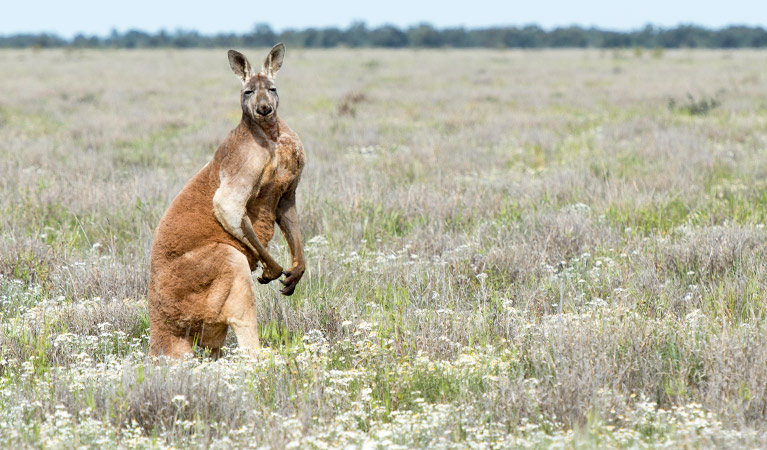
RED KANGAROO
Osphranter rufus
DESCRIPTION
The Red Kangaroo is the largest living marsupial, characterized by its powerful hind legs, large feet, and long tail, which it uses for balance while hopping. Males are typically larger than females, with a robust build and a distinctive reddish-brown coloration, while females are smaller and have a more grayish hue. They are highly social animals, often seen in groups, and are well adapted to the arid Australian environment, where they can survive with minimal water intake.
FUN FACTS
- Red Kangaroos can leap over 3 meters in a single bound and can reach speeds of up to 70 km/h when running
- Their unique method of locomotion allows them to cover large distances efficiently, making them well-suited for the vast Australian outback.|Red Kangaroos have a special adaptation in their digestive system that allows them to extract moisture from their food, enabling them to survive in arid environments where water is scarce
- This adaptation is crucial for their survival in the harsh Australian climate
QUICK INFO
Lifespan8-12 years in the wild, up to 20 years in captivit
Average Weight55-90 kg
Average Length1.3-1.6 m
Diet TypeHerbivore
Social Structuregroup — they often live in mobs consisting of several individuals, which can provide safety in numbers.
Activity PatternDiurnal
Breeding SeasonYear-round, with peaks in spring and summer
- Habitat
- Red Kangaroos inhabit open grasslands, savannas, and scrublands, often in arid or semi-arid regions. They are well adapted to the harsh Australian climate and can be found in areas with sparse vegetation.
- Biomes
- Savanna, Grassland
- Native Range
- The native range of the Red Kangaroo extends across most of Australia, particularly in the interior and western regions.
- Continent
- Australia
- Countries
- Australia
- Diet
- Red Kangaroos are herbivores, primarily grazing on grasses and leaves. They are known to consume a variety of vegetation, adapting their diet based on seasonal availability.
- Diet Type
- Herbivore
- Favorite Food
- grasses, leaves
- Social Structure
- group — they often live in mobs consisting of several individuals, which can provide safety in numbers.
- Activity Pattern
- Diurnal
- Group Size
- 5-20
- Territorial
- 0
 LC
LC
 LC
LC
55-90 kg
Weight
1.3-1.6 m
Length
1.5 m at shoulder
Height (Shoulder)
- Coloration
- reddish-brown with lighter underparts
- Sexual Dimorphism
- males are larger and more robust than females
- Lifespan
- 8-12 years in the wild, up to 20 years in captivit
- Gestation Period
- 30-36 days
- Offspring per Birth
- 1
- Sexual Maturity
- 2-3 years
- Breeding Season
- Year-round, with peaks in spring and summer
LC
Least Concern
IUCN Red List Status
- Population Status
- The Red Kangaroo population is currently stable and widespread across Australia.
- Wild Population Estimate
- over 1 million
- Population Trend
- Stable
- Endangered
- 0
- Threats
- Main threats include habitat loss due to agriculture and urban development, as well as hunting in some areas. Climate change also poses a risk by affecting their food sources and water availability.
- Predators
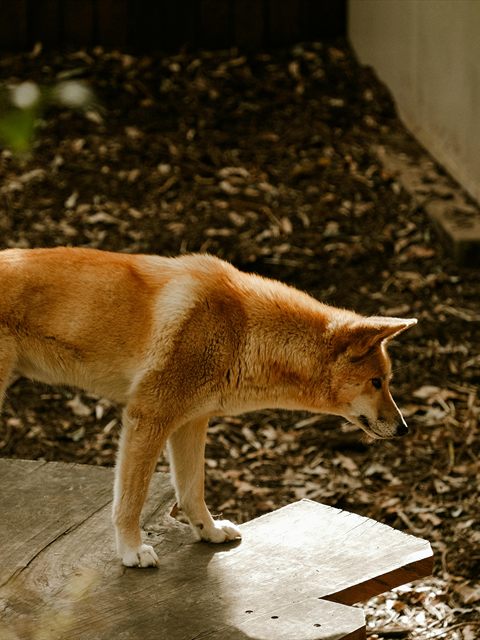
- Dingoes, eagles, and humans are the primary predators of Red Kangaroos. Young kangaroos are particularly vulnerable to predation.
- Defense Mechanisms
- They use their powerful legs to kick and can deliver strong blows to potential threats. Additionally, their agility allows them to escape quickly from predators.
- Found in Zoos
- Common