


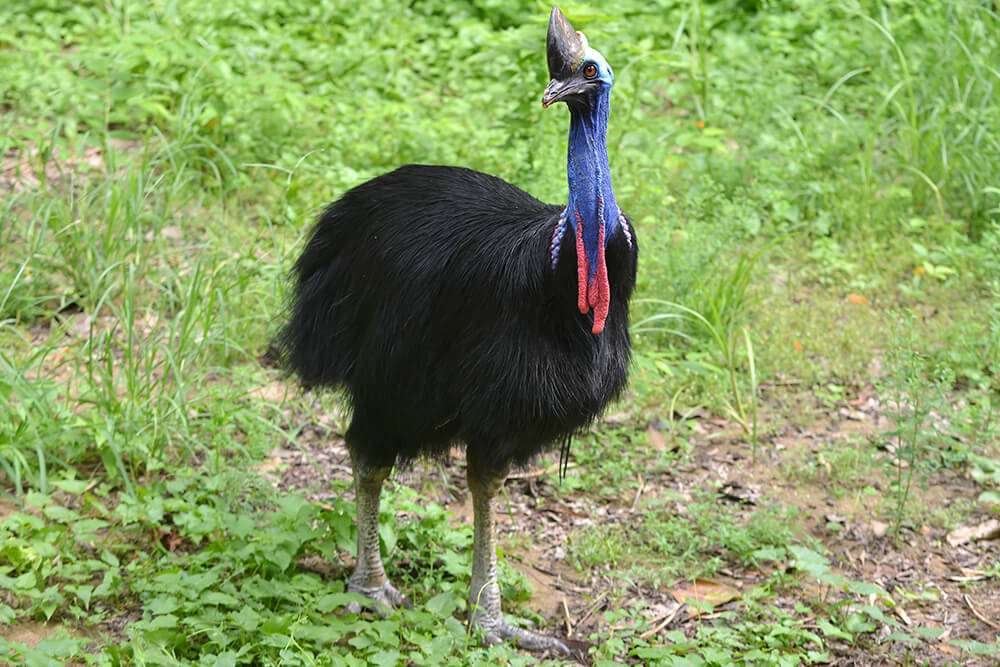
SOUTHERN CASSOWARY
Casuarius casuarius
DESCRIPTION
Also called the Australian Cassowary, the Southern Cassowary is a large, flightless bird known for its striking appearance, featuring a vibrant blue and black plumage and a prominent casque on its head. This bird can reach heights of up to 1.8 meters and is characterized by its long, powerful legs and sharp claws, which it uses for defense. Southern Cassowaries are solitary creatures that play a crucial role in their ecosystem as seed dispersers, helping to maintain the health of their rainforest habitats.
FUN FACTS
- Southern Cassowaries are known as the 'world's most dangerous bird' due to their powerful legs and sharp claws, which can inflict serious injuries
- They are also unique in that they can run up to 50 km/h through dense forest, making them incredibly agile despite their size.|The casque on a Southern Cassowary's head is not just for show; it is believed to help them navigate through dense vegetation and may play a role in communication and mating displays
QUICK INFO
Lifespan16-20 years in the wild, up to 40 years in captivi
Average Weight58-85 kg
Average Length1.5-1.8 m
Diet TypeOmnivore
Social StructureSolitary, with occasional pair bonds during the breeding season.
Activity PatternDiurnal
Breeding SeasonLate spring to early summer
- Habitat
- Southern Cassowaries inhabit tropical rainforests, where they prefer dense vegetation that provides cover and food sources. They are also found in swampy areas and lowland forests.
- Biomes
- Tropical Rainforest
- Native Range
- The Southern Cassowary is native to the tropical rainforests of New Guinea, nearby islands, and northern Australia.
- Continent
- Australia, Oceania
- Countries
- Australia, Papua New Guinea, Indonesia
- Diet
- Southern Cassowaries primarily feed on fruits, seeds, and plants, but they also consume small animals and fungi. Their diet is essential for the dispersal of various plant species in their habitat.
- Diet Type
- Omnivore
- Favorite Food
- Fruits, seeds
- Social Structure
- Solitary, with occasional pair bonds during the breeding season.
- Activity Pattern
- Diurnal
- Group Size
- 1
- Territorial
- 1

58-85 kg
Weight
1.5-1.8 m
Length
1.5-1.8 m
Height (Shoulder)
- Coloration
- Black body with bright blue skin on the head and neck, and red wattles.
- Sexual Dimorphism
- Males are generally smaller than females.
- Lifespan
- 16-20 years in the wild, up to 40 years in captivi
- Offspring per Birth
- 1-3
- Sexual Maturity
- 3-4 years
- Breeding Season
- Late spring to early summer
VU
Vulnerable
IUCN Red List Status
- Population Status
- The Southern Cassowary population is currently declining due to habitat loss and hunting.
- Wild Population Estimate
- 20,000-50,000
- Population Trend
- Decreasing
- Endangered
- 1
- Threats
- Main threats include habitat destruction due to logging and agriculture, as well as hunting. These factors have led to a significant decline in their population.
- Conservation Program
- Various conservation programs are in place to protect their habitats and raise awareness about their ecological importance.
- Predators
- Humans, large reptiles, and possibly dingoes when young.
- Defense Mechanisms
- Southern Cassowaries can deliver powerful kicks with their legs, which can be lethal to potential predators.
- Found in Zoos
- Uncommon