


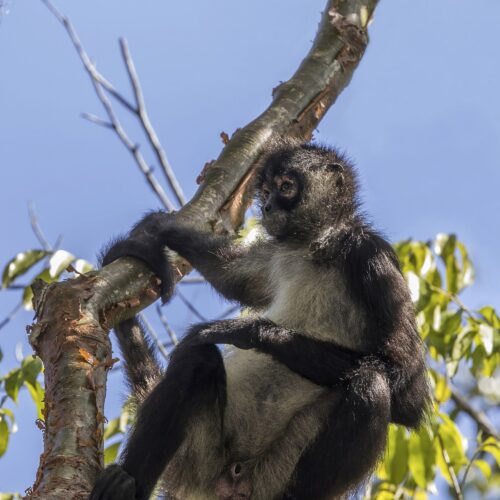
SPIDER MONKEY
Atelidae
DESCRIPTION
Spider monkeys are large, agile primates known for their long limbs and prehensile tails. They are highly social animals that live in groups and are primarily found in the tropical forests of Central and South America.
FUN FACTS
- Spider monkeys have a prehensile tail that acts like a fifth limb | They are known for their loud calls, which can be heard over long distances | Their social structure is matriarchal, with females often leading the groups
QUICK INFO
Lifespan20-30 years in the wild, up to 40 in captivity
Average Weight15-19 kg
Average Length50-70 cm
Diet TypeHerbivore
Social StructureThey live in large social groups, typically consisting of 15-30 individuals, with a matriarchal structure.
Activity PatternDiurnal
Breeding SeasonYear-round, with peaks depending on the region
- Habitat
- They inhabit tropical rainforests and can also be found in secondary forests and mangroves. They prefer areas with abundant fruiting trees.
- Biomes
- Tropical Rainforest
- Native Range
- Central and South America, from southern Mexico to Brazil.
- Continent
- North America, South America
- Countries
- Mexico, Guatemala, Honduras, Colombia, Brazil
- Diet
- Spider monkeys are primarily frugivorous, meaning they mainly eat fruits, but they also consume leaves, flowers, and occasionally insects. Their diet varies seasonally based on food availability.
- Diet Type
- Herbivore
- Favorite Food
- Fruits, leaves
- Social Structure
- They live in large social groups, typically consisting of 15-30 individuals, with a matriarchal structure.
- Activity Pattern
- Diurnal
- Group Size
- 15-30
- Territorial
- 0
 VU
VU
15-19 kg
Weight
50-70 cm
Length
- Coloration
- Generally have a black or brown coat with lighter underparts.
- Sexual Dimorphism
- Males are slightly larger than females.
- Lifespan
- 20-30 years in the wild, up to 40 in captivity
- Gestation Period
- 230-240 days
- Offspring per Birth
- 1
- Sexual Maturity
- 4-5 years
- Breeding Season
- Year-round, with peaks depending on the region
EN
Endangered
IUCN Red List Status
- Population Status
- Spider monkey populations are declining due to habitat loss and hunting.
- Wild Population Estimate
- Unknown, but populations are decreasing
- Population Trend
- Decreasing
- Endangered
- 1
- Threats
- Main threats include deforestation, habitat fragmentation, and hunting. These factors have led to significant population declines.
- Conservation Program
- Various local and international conservation efforts are in place, including habitat protection and rehabilitation.
- Predators
- Large birds of prey and jaguars may prey on spider monkeys.
- Defense Mechanisms
- They use loud vocalizations to warn others of danger and can escape quickly through the trees.
- Found in Zoos
- Common