


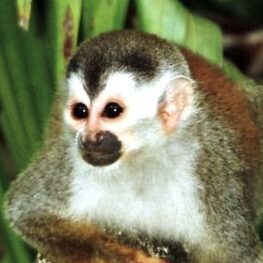
SQUIRREL MONKEY
Saimiri sciureus
DESCRIPTION
Squirrel monkeys are small, agile primates known for their playful behavior and social nature. They have a distinctive appearance with a slender body, long limbs, and a non-prehensile tail.
FUN FACTS
- Squirrel monkeys are known for their intelligence and problem-solving abilities | They have a unique way of communicating with each other through a variety of vocalizations | Their tails are not prehensile, which distinguishes them from some other monkey species
QUICK INFO
Lifespan15-20 years in the wild, up to 30 in captivity
Average Weight750-1,200 g
Average Length25-35 cm
Diet TypeOmnivore
Social Structuregroup — they live in large, cohesive social groups.
Activity PatternDiurnal
Breeding SeasonYear-round, with peaks depending on the region
- Habitat
- They inhabit tropical rainforests and can often be found in the canopy layer. Squirrel monkeys prefer areas with abundant fruiting trees.
- Biomes
- Tropical Rainforest
- Native Range
- They are native to the tropical forests of Central and South America.
- Continent
- South America
- Countries
- Brazil, Colombia, Venezuela, Peru, Ecuador
- Diet
- Squirrel monkeys are omnivorous, primarily feeding on fruits, insects, and small vertebrates. They are known to forage in trees for their food.
- Diet Type
- Omnivore
- Favorite Food
- fruits, insects
- Social Structure
- group — they live in large, cohesive social groups.
- Activity Pattern
- Diurnal
- Group Size
- 10-40
- Territorial
- 0
 VU
VU
 LC
LC
750-1,200 g
Weight
25-35 cm
Length
- Coloration
- They have a yellowish or golden fur with a darker crown and face.
- Sexual Dimorphism
- Males are slightly larger than females.
- Lifespan
- 15-20 years in the wild, up to 30 in captivity
- Gestation Period
- 150-170 days
- Offspring per Birth
- 1
- Sexual Maturity
- 2-3 years
- Breeding Season
- Year-round, with peaks depending on the region
LC
Least Concern
IUCN Red List Status
- Population Status
- The population is currently stable, but habitat loss poses a threat.
- Wild Population Estimate
- Unknown
- Population Trend
- Stable
- Endangered
- 0
- Threats
- Main threats include habitat destruction due to deforestation and the illegal pet trade.
- Predators
- Large birds of prey, snakes, and felids
- Defense Mechanisms
- They use vocalizations to alert others of danger and can flee quickly into the trees.
- Found in Zoos
- Common