


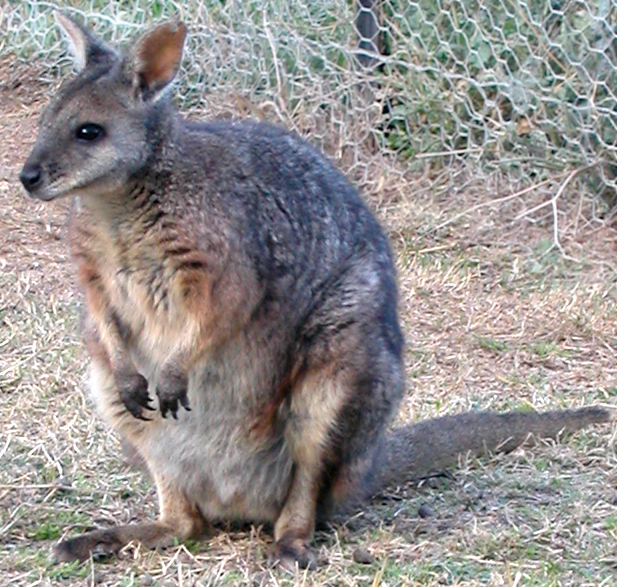
TAMMAR WALLABY
Notamacropus eugenii
DESCRIPTION
Tammar Wallaby (Notamacropus eugenii) is commonly known as Eugenie's Wallaby and is a small to medium-sized marsupial native to Australia. They have a compact body with a short, thick tail and long hind legs, which are characteristic of the macropod family. These wallabies are primarily nocturnal and are known for their agility and ability to hop quickly through their natural habitats.
FUN FACTS
- Tammar Wallabies are known for their unique hopping ability, which allows them to cover large distances quickly while conserving energy
- They can leap up to three times their body length in a single bound! | These wallabies have a special adaptation in their digestive system that allows them to efficiently process tough plant materials, making them well-suited for their herbivorous diet
- This adaptation helps them thrive in their natural habitats where food sources can be scarce
QUICK INFO
Lifespan10-15 years in the wild, up to 20 years in captivi
Average Weight8-12 kg
Average Length0.8-1.0 m
Diet TypeHerbivore
Social Structuresolitary or small groups, often seen alone or in pairs
Activity PatternNocturnal
Breeding SeasonYear-round, with peaks in spring and summer
- Habitat
- Tammar Wallabies inhabit a range of environments, including woodlands, scrublands, and grasslands. They prefer areas with dense vegetation for cover and foraging.
- Biomes
- Temperate Forest, Grassland
- Native Range
- They are native to the southern regions of Australia, particularly in Western Australia and parts of South Australia.
- Continent
- Australia
- Countries
- Australia
- Diet
- Tammar Wallabies are herbivores, primarily feeding on grasses, leaves, and other vegetation. They graze on a variety of plant materials, adapting their diet based on seasonal availability.
- Diet Type
- Herbivore
- Favorite Food
- grasses, leaves
- Social Structure
- solitary or small groups, often seen alone or in pairs
- Activity Pattern
- Nocturnal
- Group Size
- 1-5
- Territorial
- 1
 LC
LC

 LC
LC
8-12 kg
Weight
0.8-1.0 m
Length
- Coloration
- They have a grey-brown fur with lighter underparts and a distinctive dark stripe along their back.
- Sexual Dimorphism
- Males are generally larger than females.
- Lifespan
- 10-15 years in the wild, up to 20 years in captivi
- Gestation Period
- 30-32 days
- Offspring per Birth
- 1
- Sexual Maturity
- 1-2 years
- Breeding Season
- Year-round, with peaks in spring and summer
LC
Least Concern
IUCN Red List Status
- Population Status
- The population of Tammar Wallabies is currently stable, although they face habitat loss.
- Wild Population Estimate
- 10,000-15,000
- Population Trend
- Stable
- Endangered
- 0
- Threats
- Main threats include habitat destruction due to agriculture and urban development, as well as predation by introduced species such as foxes and cats.
- Predators
- Dingoes, foxes, domestic cats
- Defense Mechanisms
- They rely on their agility and speed to escape predators, often using dense vegetation for cover.
- Found in Zoos
- Uncommon