


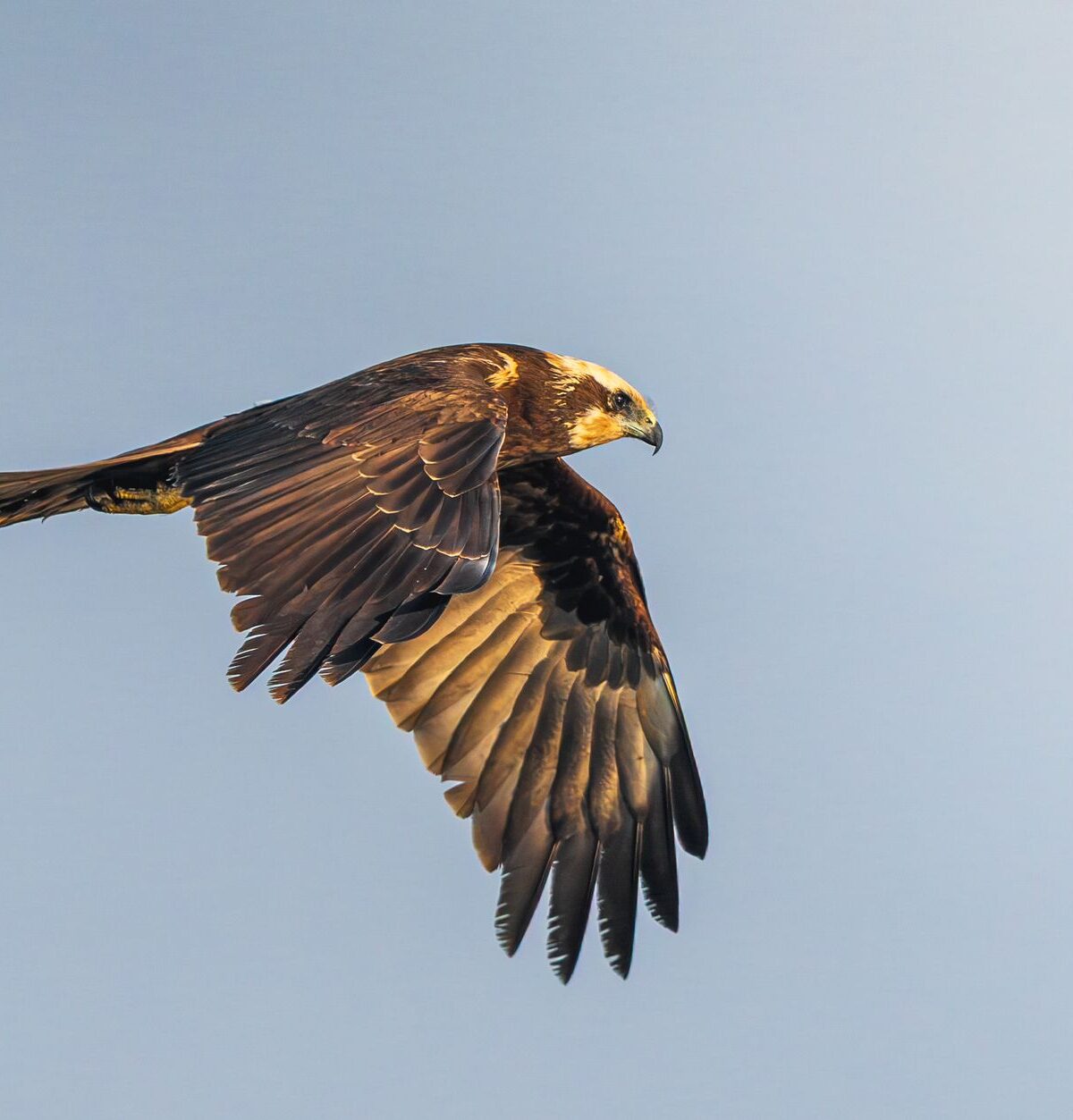
WESTERN MARSH HARRIER
Circus aeruginosus
DESCRIPTION
Western Marsh Harrier (Circus aeruginosus) is a large bird of prey known for its distinctive long wings and tail, which give it a graceful flight. It exhibits sexual dimorphism, with females being larger and having a more mottled brown appearance compared to the males, which are generally more uniform in color with a grayish-brown plumage. This species is often seen gliding low over wetlands and marshes, where it hunts for prey and builds its nests in dense vegetation.
FUN FACTS
- Western Marsh Harriers are known for their impressive aerial displays during courtship, where males perform acrobatic flights to attract females
- Additionally, they have a unique hunting technique where they glide low over the ground, using their keen eyesight to spot prey hidden in the vegetation
QUICK INFO
Lifespan10-15 years in the wild
Average Weight500-1,000 g
Average Length45-55 cm
Diet TypeCarnivore
Social Structuresolitary, pairs during breeding season
Activity PatternDiurnal
Breeding SeasonSpring (March-June)
- Habitat
- This species inhabits wetlands, marshes, and reed beds, where it can find ample food and suitable nesting sites. It prefers areas with dense vegetation for nesting and open spaces for hunting.
- Biomes
- Wetlands, Marshes
- Native Range
- The Western Marsh Harrier is found across Europe, parts of Asia, and North Africa, with migratory populations moving to sub-Saharan Africa during winter.
- Continent
- Europe, Asia, Africa
- Countries
- United Kingdom, France, Germany, Spain, Italy, Poland, Russia
- Diet
- The Western Marsh Harrier primarily feeds on small mammals, birds, and amphibians, often hunting by flying low over the ground to flush out its prey. It is known to scavenge as well, taking advantage of carrion when available.
- Diet Type
- Carnivore
- Favorite Food
- small mammals, birds, amphibians
- Social Structure
- solitary, pairs during breeding season
- Activity Pattern
- Diurnal
- Group Size
- 1-2
- Territorial
- 1
 LC
LC
 CR
CR
500-1,000 g
Weight
45-55 cm
Length
- Coloration
- Males are generally grayish-brown with a distinctive dark cap, while females are mottled brown with a lighter underside.
- Sexual Dimorphism
- Females are larger and more heavily patterned than males.
- Lifespan
- 10-15 years in the wild
- Offspring per Birth
- 3-6
- Sexual Maturity
- 2-3 years
- Breeding Season
- Spring (March-June)
LC
Least Concern
IUCN Red List Status
- Population Status
- The population of Western Marsh Harrier is currently stable in many areas, although it faces threats in certain regions.
- Wild Population Estimate
- 20,000-30,000
- Population Trend
- Stable
- Endangered
- 0
- Threats
- Main threats include habitat loss due to drainage of wetlands and agricultural expansion, as well as persecution and disturbance during the breeding season.
- Predators
- Eagles, large hawks, and humans can pose threats to Western Marsh Harrier, particularly to their nests and young.
- Defense Mechanisms
- They may use evasive flight and nesting in dense vegetation to avoid predators.
- Found in Zoos
- Uncommon