


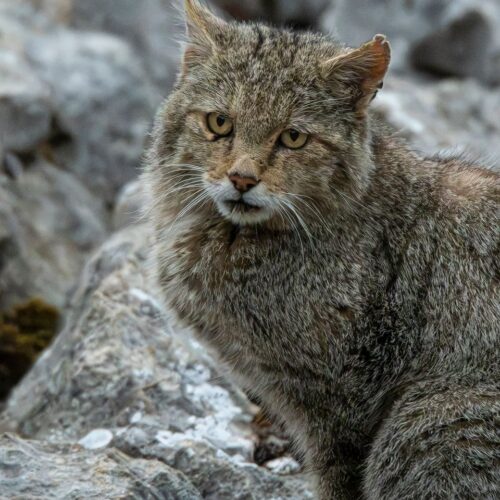
WILDCAT
Felis silvestris
DESCRIPTION
The wildcat (Felis silvestris) is a small, elusive feline known for its robust build and distinctive features. It has a short, bushy tail, pointed ears, and a coat that varies in color from gray to yellowish-brown, often with stripes and spots that provide excellent camouflage in its natural habitat. Wildcats are primarily solitary animals, exhibiting territorial behavior, and they are highly adaptable, thriving in various environments from forests to grasslands.
FUN FACTS
- Wildcats are considered the ancestors of domestic cats, and their behavior and genetics have significantly influenced the traits of house cats
- They are also known for their incredible adaptability, being able to thrive in various environments, from rural areas to urban settings, as long as there is sufficient cover and prey available.|Despite their small size, wildcats are fierce hunters and can take down prey much larger than themselves, showcasing their strength and agility
- Their ability to camouflage effectively allows them to stalk prey without being easily detected, making them highly efficient predators
QUICK INFO
Lifespan10-12 years in the wild, up to 15 years in captivi
Average Weight3.5-6.5 kg
Average Length45-80 cm
Diet TypeCarnivore
Social Structuresolitary, with individuals maintaining their own territories
Activity PatternNocturnal
Breeding SeasonSpring (March-May)
- Habitat
- Wildcats inhabit a range of environments, including forests, grasslands, and scrublands. They prefer areas with dense cover for stalking prey and for shelter.
- Biomes
- Temperate Forest, Grassland, Scrubland
- Native Range
- Wildcats are found across Europe, Africa, and parts of Asia, with distinct subspecies adapted to different regions.
- Continent
- Europe, Africa, Asia
- Countries
- United Kingdom, France, Germany, Italy, Spain, Russia, Turkey, South Africa
- Diet
- Wildcats are carnivorous and primarily hunt small mammals, birds, and occasionally reptiles. They are skilled hunters, using stealth and agility to catch their prey.
- Diet Type
- Carnivore
- Favorite Food
- small mammals, birds
- Social Structure
- solitary, with individuals maintaining their own territories
- Activity Pattern
- Nocturnal
- Group Size
- 1
- Territorial
- 1
3.5-6.5 kg
Weight
45-80 cm
Length
- Coloration
- varies from gray to yellowish-brown with stripes and spots
- Sexual Dimorphism
- males are generally larger than females
- Lifespan
- 10-12 years in the wild, up to 15 years in captivi
- Gestation Period
- 63-68 days
- Offspring per Birth
- 1-5
- Sexual Maturity
- 1-2 years
- Breeding Season
- Spring (March-May)
LC
Least Concern
IUCN Red List Status
- Population Status
- The wildcat population is currently stable in many areas, but it faces threats in others.
- Wild Population Estimate
- unknown
- Population Trend
- Stable
- Endangered
- 0
- Threats
- Main threats to wildcats include habitat loss, hunting, and hybridization with domestic cats. These factors can lead to a decline in their populations in certain regions.
- Predators
- larger carnivores such as wolves and eagles may prey on wildcats, especially young or injured individuals.
- Defense Mechanisms
- Wildcats rely on their agility and stealth to evade predators, often using dense vegetation for cover.
- Found in Zoos
- Uncommon